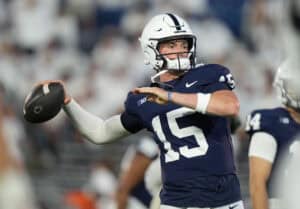
What does it take to “build quarterback mechanics?”
The Pittsburgh Steelers selected QB Drew Allar in Round 3 of this year’s draft. He fell out of Round 1 for two classic reasons. First, he has all the above-the-neck issues we expect from any young man leaving a school where he played in a poor-even-for-college offensive scheme. We’ve all read about how much that step to the next level requires. The speed of the game increases; the processing time shrinks; the size of the playbook octuples; the defensive alignments include things one never imagined; the defensive shifts, disguises, and deceptions boggle the imagination; and many other factors. It’s fascinating stuff that I understand in the abstract, but cannot say I’ve ever experienced in person.
Drew Allar faces a huge mental learning curve, but he also has footwork and other body mechanics issues so severe that his film shows random throws into the ground, others high, and still more out the receiver’s reach. This I can explain, along with how he will try to fix it.
Rebuilding a QB’s throwing mechanics used to be viewed as impossible
I started covering the draft some 20 years ago, and ran face first into an accepted truth that drove me nuts: “You can’t teach accuracy.” People held to that passionately. “Accuracy is built on a lifetime of habits, and you cannot change those as an adult.”
This bugged the four-letter word out of me because I knew better. I grew up as a pitcher, where the opposite adage applies: “Young hurlers don’t solidify their mechanics or accuracy until they get in the hands of a good, professional pitching coach.” Insert hundreds of famous examples. After blowing my shoulder to smithereens I moved on to several years of practicing, teaching and critiquing a few obscure martial arts, particularly from the body mechanics point of view where I have a natural gift. I have personally helped dozens of men and women to tear down their bad habits and replace them with proper ones. So I have heard about the things that young QBs need to do, I have done those things in other sports, I have taught those things, and I’ve seen it work.
That background made me push back against the can’t be fixed line. Which only led to another objection: “I’ll take you at your word about other sports, but have you done it with quarterbacks? No? Well, it’s different for football players. I can’t say why, but it is unless your name is Bill Walsh.” How could I argue with that? They’d grown up in the game, I hadn’t, and who knows? Maybe there really was a major difference that I didn’t know enough to imagine.
But that didn’t stop it from bugging the four-letter word out of me.
Then we started to hear about exceptions. Walsh pioneered the idea that poor mechanics could be improved, and he taught what he could to student coaches such as a young assistant named Mike McCarthy. Then came Jordan Palmer, who opened an offseason quarterbacks school that promised to fix all problems by using high speed cameras and sports medicine advances. “We will identify what your bad habits are down to the particular muscles and alignments, then develop a customized program to help you replace, repair, and then improve on those issues.”
Palmer then produced a whole string of success stories who sang his praises to the sky. Kyle Allen. Drew Lock. Josh Allen (who needed a ton of help fwiw). Patrick Mahomes. And those are just the headliners. NFL QBs like Aaron Rodgers swore they could never have succeeded without their specialized coaches (enter Mike McCarthy again).
Within three or four years you could not find a star QB who hadn’t signed on: “What do I work on in my offseason? Footwork. Everything starts with your footwork.” Peyton Manning was an apostle. Ben Roethlisberger, Drew Brees, and Tom Brady joined the church as well. Rich Gannon gave newly improved mechanics the credit for his late career revival. Fans could see the difference too, as throwing motions tightened up, and NFL accuracy soared to heights that had never been seen before.
Here in the 2020s there’s a new adage: “QBs hit the league, and then survive as best they can until they either bust out or refine their mechanics.” Lamar Jackson is a perfect example. He changed the world with his running ability, but regularly lost the big games. A classic shooting star who’d last until the injuries started to pile up. Then he fixed those mechanics and suddenly became a force of nature.
What does “body mechanics” actually mean?
Quick summary: power comes up from the ground, through the body like water through a hose, and then out through the punch, kick, throw, or what have you. Kink the hose and that flow will go kerplooey, leading to random and erratic results. Body dynamics is the study of how people move, and body mechanics is the craft of teaching the right ways to move – all in order to unkink that hose.
All those young players who make ten astonishing throws in a row, only to drive the next two into the dirt? It happened because the mechanics aligned for the first few, then fell apart for the next, and the results went kerplooey.
That hose can kink at any point in the chain, with the toughest ones to fix starting down at the base.
Working on balance and footwork
Bend the hose at the tap and nothing can ever go right further on without brilliant improvisation to compensate for the spurts, sprays, and dribbles. So it is with misaligned or unstable feet that throw the balance off. {NOTE: Real masters will stress that balance is built on breathing, but that gets really arcane.} Here’s an example. Can you move your feet with athletic poise, without thought, in any direction, and still maintain your balance well enough to be just as ready regardless of where you are in the movement? Try going around a tight corner in both directions at full speed. That’s a simple example. Are you ready to ‘throw the ball’ at any point in the movement? Or even at the instant you land? Or do you have to regroup for a second? The closer you are to nailing that down, the better your body mechanics.
It takes most people two or three years to understand that kind of “natural” balance. It isn’t easy, and no one but the greatest champions ever gets close to mastering that fundamental basic. But I promise you it can be learned. In fact, I will now make a prediction: at some point in minicamp we’ll hear eye-rolled stories about the young QB’s stumbling through drop-back drills at a snail’s pace. “Oh lord, what kind of klutzes have we drafted?!” That will all be due to this first lesson: what “proper alignment” means, and how to make sure you stay aligned as you move. {NOTE: this article was written before mini-camp, when the news suddenly filled with that discussion.}
FWIW, getting to “basically okay” equates to being a raw, newly minted black belt. It’s the point where young men start to feel their oats. “I’m no longer a helpless victim! And wow, look how hard I’m hitting!” It never takes more than a year or two more before they realize how raw they still are, but trust me: it’s a memorable stage for everyone on the outside. Sorry about the digression.
In any case, the good news is that young black belts really are ready to face real competition, and to build from there into true expertise. The same is true for quarterbacks. Once the feet are basically okay, the the young men can really dig in to challenge themselves against NFL competition, and see if they can succeed. Until then they’re racehorses with a 30 pound weight in the saddle. Which brings up two points to keep in mind as the article moves on. First, QBs who haven’t refined their mechanics to at least that level are the next best thing to doomed – “handicapped” in racing parlance. And second, it takes regular human beings several (or many) years of hard, devoted work to reach that point. Often as many as ten.
An aside about learning speed
Just about now you’re starting to challenge the premise. “Why haven’t these kids learned those basics in high school and college? Besides, these are some of the greatest athletes on earth. They’ve got to learn faster than regular human beings! The mere fact that so many young quarterbacks succeed early in their careers proves that you’re exaggerating Scott.”
Not exactly. First, it’s terribly hard for teenagers to learn this stuff because their bodies are still changing. High school athletes can close in toward good mechanics, but it’s nigh impossible for the things that carry a teenager to be exactly the ones that will work for their adult bodies.
Second, teenagers aren’t exactly known for deep focus and discipline. This is where coaching comes in – which requires yet another quick digression. How the heck do you find the sweet balance needed to inspire, discipline, teach, and encourage young men of that age who come from every different level of native skill? And every kind of background? I suck at it, and have nothing but awe toward those who possess that gift. Give me adults any day and every day.
Third, who did they have to teach them? I can’t do what those coaches can but, with all due modesty, there aren’t many of them who possess my particular gift for seeing how moving bodies shift in and out of alignment, and for translating that intuitive function into parts and pieces. Let alone lessons plans. I’ve known a few men who were even better at it than me, and many who could teach what I was saying to students I couldn’t have reached. But teaching this stuff takes all those gifts together, on top of passion for the game, knowledge of the Xs and Os, and some basic human wisdom. It adds up to such a rare combination that people really did believe accuracy could not be improved for quarterbacks who reached the NFL.
Fourth, you’re quite right great athletes grasp physical movements better, faster, and more intuitively than the rest of us. And they often have discipline amounting to obsession when it comes to learning physical activities. But they’ve also succeeded all their lives on those natural gifts. How many really buy into all of this metaphysical stuff, let alone believe it makes a major difference? I suspect that a lot of them are exposed to these concepts, just as I was to the idea that my mechanics would need to change once (okay, if) I made it up to professional ball. I just didn’t know the particulars of what I didn’t know. Same for these young men.
Lots of winnowing points. Those who make it through all of them become first round picks.
Back to the feet
So now we have you balanced in a sustainable way. But “balance” is a somewhat flexible term, and it changes a bit with how your feet get aligned, and how you move them. Feet in one position enhance flexible movement. Feet in another (slightly pigeon toed fwiw) enhance power. Lunging with an epee is very different from lunging with a heftier weapon, and lunging itself can be totally different than moving in c-steps, or treating it all as shifts from stance to stance. Activated feet enhance reaction time, peripheral vision, and movement. Grounded feet help you to burrow inside, help focused vision, and support clumsy weapons (or baseball bats). Balance on the inside ball of the foot? The balls of the feet plural? Or the midfoot? It matters; but never, ever get over your toes, on your heels, or falling sideways! Those are cardinal sins – unless you’re good enough to turn it into a trap, or know how to disguise a shift from a balanced left foot lead to a balanced right foot lead.
Head spinning yet? I meant it when I talked of hard work over a course of years. But that’s what it takes to understand, replace, and rebuild the fundamentals. At least down where your body meets the ground. There’s a whole lot more to follow.
Next up: the knees
Are they slightly bent, in that natural, athletic position? Are they wide enough to bob, weave, and generate power? Are they narrow enough to move your body far enough to matter? And does your stance create any tension in the system? That last matters more than anything else. Balanced tension throughout the body is essential. Imagine a hose that’s thicker in some parts and flaccid in others. Will the water flow smoothly through a hose like that, even in your imagination? Balanced tension – neither tight nor flaccid – is how humans solve the problem. With variations for all those different types of movement.
Great athletes do a lot of this naturally, but what they’ve learned often conflicts with the new, more precise, and all-important footwork.
For what it’s worth, I had a hard time teaching this general concept until I came up with some tricks. First, I told people to find some film of Ted Williams swinging a bat. What makes it so perfect, and so beautiful? Then I’d tell them to find some cheap boxing show on TV. Thursday Night Fights, or whatever they call it now. Wait a month and sooner or later there will be an episode where both of the up-and-comer fights ended in an early KO, and the network had to show one of the undercard fights. New people watch those undercards and come back with huge grins. “These people are awful!” Which leads to the kicker: “No. They’re not. Those are trained, dedicated, professional fighters who would break us and any three of our friends without raising a sweat. They just look bad compared to the not-quite-contenders you watched in the headline fights. What’s the difference? That is what we’re trying to learn.”
The next step would be to film your own movements to see where they look compared to your sport’s equivalent of a fringe contender. (The great ones are harder to analyze because their flaws are so subtle). I never reached that level of training, but talking about it brings to mind an interview with Will Howard the other day. He talked about Coach McCarthy sitting down with him to watch six years of practice and game film on young Aaron Rodgers. McCarthy went through every snap, showing how Rodgers continually improved. McCarthy apparently has a library of film on other QBs as well, beginning with Joe Montana. Howard sounded awed. “What a difference from beginning to end!”
Color me impressed. A day or two of history and the young QB really understands the sort of things he didn’t know enough to know, and can visualize what he might be if he nails them down. One begins to understand how Mike McCarthy earned his reputation as a QB Whisperer.
Teaching the hips
This is where most of the problems occur (especially for women who have a natural swivel). The hips, core, and shoulders need to move as a unit. I cannot tell you how many punches and cuts I’ve seen that fizzled out at the waist. I gather that many quarterbacks have terrible problems with this – Drew Allar among them. (“Understand” because I have not done a study on my own). It doesn’t matter which goes first. Shoulders ahead of hips, or hips ahead of shoulders, the result is the same. The hose kinks, the power goes kerplooey, and what leaves the hand will be random compared to what it would be if you maintained alignment.
I know of only one way to teach this. Explain the problem, convince people it’s true, design drills that show off the errors, and then do 10,000 repetitions until things tighten up and new habits form. Physical training helps, but it’s more neurological than a matter of strength. Physical strength can actually disguise the problem. Balanced tension must be job #1!
A quick digression. Feet, knees, hips, balance, and balanced tension; those are the fundamentals. People need to work on those fundamentals from both left and right if they really want to learn.
Dominant hands develop differently because they get used more. They develop a whole network of tiny control muscles of the sort that let you spin a ball powerfully, and in just the right way. Fingers, hands, wrists, forearms; look at your own and you’ll see they aren’t the same. Look at professional tennis players or swordsmen if you want an extreme example! Neurology is part of why your left and right hands seem so different, but it’s also about having all that extra muscle to obey the nerves and do what’s being asked.
Those differences are nowhere near as stark for feet, hips, arms, and movement in general. Dancers may prefer to spin in one direction over another, but they learn to do both – and they must, because going the “wrong” way helps you learn to do it better in the more comfortable direction. Similarly, it’s a rare basketball player who can do jump shots equally well with either hands, but every good one learns to dribble with both, and drive in on both sides for a layup.
Cross training from right to left and left to right is essential to real mastery. Not with the final blows or throws. Dominant hands will be dominant. But movement skills must be at least close to equal in both directions, or the underlying fundamentals will be distorted.
I’d bet money that Coach McCarthy asks his QBs to mix in drop backs as if they were lefties instead of righties for just this reason. Doing that simple act backwards will drive the young men crazy. But as the weak side starts to learn, the strong side will automatically grasp how much better things go if you strictly comply with how the coaches want you to move. That was one of my best tricks for showing people how much their dominant hand was cheating to get by; and by implication, how much better it could get.
This is also why the idea of training offensive linemen on just one side drives me so bananas. They may have a more natural side, but failing to train both will cap how far the player can progress. Right tackles must learn to be competent on the left, and vice versa, or you’ll have someone who never achieves his full potential. It’s about balanced movement and balanced tension, like spinning your dance partner in either direction; not about swinging a golf club or throwing a ball where all those little control muscles come into play! Grrrr.
Moving on up
Feet, balance, and balanced tension; knees, movement, and balanced tension; hips, core, and upper body, where balanced tension matters even more; and then up to where the throwing actually happens. I made a list for writing this article. If I was teaching this, I’d break it down to arm angle, release point, grip, snap for power, spin for spiral, release, and follow through. And lest you think I’m simply piling on words, those come from looking at the shoulder, elbow, hand, wrist, fingers, fingertips, and follow through.
How do we strengthen each of those links without kinking the hose? And then, how do we instill the new throwing motion so deep that it becomes instinctive even under pressure? Multiply if you want to be one of those who throws from different angles. Consistent results come from consistent training and endless repetition. Tens of thousands of times, doing it ever closer to right, and drowning out the habits of a lifetime. That’s the path to NFL accuracy.
Digression: I do not believe in my heart that anyone – even a physical genius – can really be as accurate if their release point changes. Patrick Mahomes and Aaron Rodgers come as close as I’ve ever seen to that, but look really close and you’ll see how little that angle really changes. It isn’t the arm so much as leaning the whole platform to the side. Still a great trick, and I’m not belittling it, but it actually proves the rule. The throws that truly come “off platform” will be shorter, less zippy, and less accurate. Prove me wrong.
Throwing motion may sound like a fundamental, but it’s actually the very end of the chain. The tip of the whip. That’s what makes all the true fundamentals so hard to grasp, and thus to teach. It’s also the sort of thing that players continually refine even after they’re good at it… which brings us full circle.
Again: I realize the mental aspect is even bigger
Remember your first real job as an adult? How hard it was to simply muddle through? You were the same age as these young quarterbacks, give or take. They are as helpless, ignorant, and puppyish as you and I were. How long did it take you to get your footing? Why do you think it will be faster for these young men? There’s challenge #1 for a young QB.
Then you have challenge #2, in the form of tearing down and rebuilding all those faulty body mechanics described above. Prospects who already have good body mechanics go in Round 1 because they are ready to learn, without tearing down and rebuilding. This does not mean that Allar cannot become everything a Round 1 pick could. He has that potential. He just has many more opportunities to fail on the long path to getting there.
Once you have first-degree body dynamics, they will inevitably need to improve over time. Can you do that? Challenge #3.
Then you get to all those above-the-neck parts of the game. Their first job calls for swallowing an NFL playbook, which is nothing like they’ve ever seen. Challenge #4. They must learn to see through defenses built on deception. Challenge #5. They need to increase their see-to-do processing to all but impossible speeds (challenge #6); study the game so deeply that they instinctively know where everyone on the field is (challenge #7) and is moving (#8); develop chemistry and timing with all their teammates (#9); and all those other things I don’t know enough about to mention. All while maturing from college kid to grown man; from young man into being a professional; while getting married; having kids; dealing with your old friends and family; and doing all the rest of the things required of an adult in modern America.
Oh yes. And they’ve got to do it quickly! Fans get furious if your aren’t fully up to speed in year 2. You lazy, irresponsible, waste of a pick you.
No wonder Sam Darnold saw ghosts.
Translating this to the Steelers
No, I have not trained quarterbacks. But I know what I’m talking about when it comes to body dynamics, and I’m here to guarantee that replacing bad habits with new ones takes several years for talented human beings who care about doing it. Often as long as a decade. Worse yet, putting someone like Drew Allar onto the field before he has that new framework will only cause him to lose what he’s learned, and revert to old habits. Game repetitions will hurt, not help! Hence another old adage: Impatient teams fail their young quarterbacks far more often than those quarterbacks fail the teams.
All of which puts huge pressure on everyone to speed up that learning curve. I meant what I said about normal people requiring a ten year timeframe to learn the purely mechanical part of what Drew Allar needs to know. That’s a nonstarter obviously enough. But how can they speed that up? Behold the magic of professional athletes, combined with professional coaching, multiplied by the hothouse environment of an NFL locker room, NFL training facility, and NFL teammates.
Fans want to see the youngsters out on the big stage. Coaches want to train them in seclusion. Guess who’s right?
The required time will change with every individual involved in that chain, starting with the player but also including the coaching, the team, and the teammates. I have no answer for any specific prospect. I only hope I’ve done enough to understand how monumental the challenges the task really is, and how much we should admire those who try. And especially those who succeed.
I also hope this reveals how very hard you and I need to work on controlling our fellow fans. “Get those young men on the field ASAP so we can see what we’ve got! You can’t start learning until you’re taking life snaps under fire!” Bull{ahem}. Keep those young men confined to the practice field until they’ve rebuilt their fundamentals to an acceptable NFL standard! Then begin to put them under fire in ways that will help them to learn. Move too fast and we won’t “see what they’ve got” at all. We’ll see the crippling of their chance to become what they could.
Football and life
I earned my law license in 1991, became a business attorney, and have done that work ever since. Over the years I have given many talks for the SBA, and hundreds of talking-tos with people who came to me for help in starting their business. I inevitably start by asking them the same thing: “Do you have a written business plan?”
Something like 60-80% of new businesses fail within three years. That number drops to more like 20-30% if you limit the pool to entrepreneurs with a written business plan. People don’t like to believe that, and ask me why that’s true. Here’s how the conversation goes from there: “You’ve heard that business owners constantly work 60 and 70 hour weeks?” Eager entrepreneur nods. “The reality is more like 120 hour weeks.” Look of shock. “They’ve just learned to compress that impossible amount of work in half.” Ohhhh…. “Until you really understand where that 120 hours could go, and how you’ll find a way to do it, you’re leaving things up to chance that you shouldn’t. Business plans force you to think that out in a disciplined way.”
Do you plan to someday go out on your own? Consider that free advice from someone who others have to pay.
There’s an analogy to be drawn between would-be NFL quarterbacks and would-be entrepreneurs. Those QBs also have vastly more work to do than any normal human being can manage, especially if they need to tear down and rebuild their throwing mechanics. 250 hours per week rather than 120. Great coaching, great mentors, great environments, and a whole lot of patience from management can cut that down to a mere 120. But it’s still a mind boggling task worthy of serious respect.
Bringing it home
Accuracy really can be taught nowadays, but it isn’t easy or fast. And it doesn’t guarantee success. It only means they have a real chance.
I understand that Will Howard showed great progress in his rookie year off, and has now reached the point where he may be able to gain traction in his climb toward becoming a real NFL quarterback. That’s a great feat, which most young men in his shoes never manage. He may even be ready to test himself against NFL opponents a few times, in order to start learning how far he needs to go. (And how to do it, of course). My fingers are crossed, but I’ll have to trust in the coaches who can actually see where he is in the process.
Drew Allar is in a different place. He needs to fix basic physical things; a challenge that Howard has already passed. He can start to learn the mental part of the game in parallel, but snaps under fire should be totally off the table.
Allar got picked earlier because of the potential. It’s hard to see Will Howard as the next Aaron Rodgers even if everything goes right. A top-20 starter, though? Absolutely. If all those ifs come out the right way.
Allar could be all of that, but has a longer way to go. He hasn’t yet proved all those things that Howard did in his successful rookie season, and he has an even more profound need to tear down and rebuild his body mechanics: feet, balance, knees, hips, core, shoulders, etc. Only then will he be ready to trim his focus down to the even tougher mental parts of the game. You and I can only cheer him on while trying to dig through the coach-speak for better clues than our fantasies. And we can thank heaven if Aaron Rodgers comes back, because his ability to guide those young will make their work easier, faster, and better. They need him, and they need the breathing space he will provide.



Enlightening read! This is the type of article that I come here for, and why SCN kicks a$$. Thanks Scott.
Good read! FWIW allar seemed to be making progress at least in his footwork before the injury so it’ll be interesting to see if he can that back up quickly. Also u agree that Howard is at the point where we need to see if his progress translates on the field. It will be an interesting season
I can’t really say. I haven’t seen him practice. The coach speak and a few player comments suggest that, but none of us can really know.
He did succeed in getting through Year 1 without any issues we’ve heard of. That’s a promising sign. Many rookies simply can’t handle the demands of being a pro.
Given all the above, there’s at least a strong expectation that Drew will play in preseason games. How does one accomplish that while his fundamentals still need lots of improvement and throwing him into the fire may well cause regression?
Nailed the problem in one. And it’s even worse because they say you really can’t work on a lot of the mental stuff until you DO see it in person.
I would love to ask the coaches about that balance.
Personally, I would guess it comes down to letting people fail in relatively brief ways, with lessons built on those failures. Coach recently spoke of building a video baseline of everything the young QB does, and reviewing it constantly as things change. That sounds like a great idea. Catch hard proof of the regression, and maybe you can turn it into motivation for working that much harder on changing the old habits.
Preseason is the time of vanilla defenses, though, so I don’t think the mental aspect should/would be too taxing on either of the young guys.
Preseason is really like a hard practice in reality. Allar will absolutely need to work on the fundamentals, but they’ll have him also work on all the other parts at the same time. I really trust McCarthy to dial in the right amount of mental work with the right amount of physical work for a young QB. They’ll review the preseason tape like a practice and use it to continue to advance his growth.
That was a ton of words, but it was a really great read. Thanks!
a true Pittsburgh Steelers fan, since the 70’s the Steelers coaches will bring out all of Drew Allar talents
I’m late to the party here, but what a great read.
I’ll start with this: I have spoken with NFL coaches who do not believe you can significantly improve a QBs accuracy. By the time he gets to the league, he has fossilized habits that are almost impossible to break — particularly nowadays, when kids start throwing at such a young age and all have their own QB coaches by the time they’re 13. They believe you can tweak throwing motions, remake footwork, speed up progressions, etc. But an inaccurate QB in college is likely to be an inaccurate QB in the NFL.
I’m torn on the subject. I understand what these coaches are saying. I’ve worked with QBs who were very tough to fix. Some had issues with mechanics that compromised accuracy. Others lacked a feel for throwing a ball with touch. Some never quite mastered muscle memory. My wife, who grew up in the world of dance and gymnastics, has as perfect body control as anyone I’ve met. But she cannot for the life of her throw a football or shoot a basketball. The mechanics escape her. Granted, she hasn’t repeated those actions thousands of times to improve her skills. But she lacks a feel for the act. Maybe some athletes can’t be fixed in certain aspects.
On the other hand, as a coach, I reject the notion that players cannot improve with good coaching. There’s probably a cutoff at which point someone is going to be who they are. But it’s a lot later than 21 or 22 years old. Watching Drew Allar on film, it looks like he understands touch, and when a ball needs to be ripped into a tight window versus feathered to a spot where a receiver can run under it. What he doesn’t seem to have is consistency, whether it’s his footwork, his decision-making or his command of the position. With good coaching and plenty of reps, I believe he can acquire those things. How long will it take? It’s hard to say. Maybe it will happen fast enough to provide him an opportunity to be QB1 in Pittsburgh. Maybe it won’t click until later in his career, in a different spot, like it did with Sam Darnold. Maybe it will never occur. But if you’re Mike McCarthy, you have to believe you can fix him. Otherwise, why even draft him?
I don’t have a lot of faith that Allar will ever be QB1 in Pittsburgh, but that’s based more on statistics than anything else. Over the past decade, less than 10% of QBs taken outside the 1st Round have become starters in the league. Allar is up against it. But the tools are there with him, much more so than most 3rd Round picks. If McCarthy is indeed the QB-whisperer he’s billed to be, Allar may become the exception rather than the rule.
I thought enough of this article that I sent it to my kid who is interested in physical fitness and coaching.
I blush.