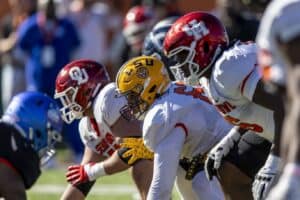
Understanding And Scouting Offensive Line Play
I just published a pair of articles on the Steelers offensive line, and the OL prospects the team will consider in the first few days of the draft. There were a lot of comments, which made it clear there’s a general misunderstanding of how to evaluate what linemen do, how they win, how they lose, and the ways we fans should be evaluating them. This article aims to outline all that, and then to use Mason McCormick and Broderick Jones as examples.
- Many thanks to Coach Kevin Smith for helping me flesh this out, and providing some anecdotes to illustrate the points. Our exchange on the current starters is quoted down below.
Oooookay. First things first. You know how people use the phrase “skill positions” for those who touch the ball, but not for the offensive and defensive lines? Folks, that is bass ackward. Players at the so-called skill positions can succeed even in the NFL if they have sufficient natural gifts. Offensive linemen cannot. Players on the OL live or die with their level of technique, combined with the fact that achieving a tie usually amounts to a win. Physicality, size, and even strength are secondary so long as they meet the bare minimums, and only come into play after that technique is fundamentally sound.
If that sounds fishy, think back on whatever competitive sport you have played in a serious way.
Take baseball. Every throw from a great pitcher looks exactly the same coming off his hand. The ball moves differently because of grip, pressure on particular fingers, and slight twists of the wrist at the last possible second; i.e., things a hitter cannot see. Great batters can hit anything if they reliably know which pitch is coming, and thus consistent, perfect technique matters more than native talent like velocity.
It’s even clearer in combat sports like boxing, wrestling, martial arts, and weapons work. Did you know that it’s physically impossible to react in time to a clean, professional jab or sword thrust? That’s not an exaggeration! Measured from the starting spot to point of contact, clean attacks will arrive quicker than the time it takes for visual signals to reach the brain, and return signals to reach the muscles. It’s not even close – like magicians doing sleight of hand. Yet people make those blocks and parries all the time, and good ones do it with disdainful ease. How?
The answer comes from reading the attacker’s shifting weight, how particular muscles will tighten or release in anticipation, the paths your opponent can actually move to with force, and all that allows you to react before the impossible speed begins. Again; I know whereof I speak. This is 100% guaranteed.
Wrestlers train obsessively for even the slightest physical edge, but every one will tell you the sport ultimately comes down to who is best at reading and applying leverage. Reading the opponent is why black belts win every time against newbies with vastly more native speed and athleticism. No one, however talented, can hit an opponent who knows what you’re about to do, and that opponent can hit you instead.
- NOTE: Zach Frazier was a historically great H.S. wrestler. Possibly the best that West Virginia ever produced. You can see it clearly in his feet and hips if you look for it, and those recognition and leverage skills no doubt explain his quick adaptation even to NFL competition.
All this applies directly to offensive line play. What do DTs and pass rushers look for when they study film? They search, in ultra slow motion, for any little flaw in how the OL moves, shifts his weight, telegraphs his punch, or reacts to a particular kind of attack. And then they plan out a whole repertoire of ways to trigger that flaw, while being in position to take advantage.
- Anecdote from Coach Smith: I once saw Mike Munchak at a coaching clinic talk for an hour about the first two steps OL take when blocking inside and outside zone. He did an entire hour on how block emanates from those first two steps. And then of course hands come in, and pad level, and hips, etc. It’s probably the most technical position in football.
- I’ve been an OL coach off and on over the years. Never played OL myself, so I had to talk to lots of line coaches and go to plenty of clinics. The three things they all emphasize: 1. first steps 2. pad level 3. physicality. Physicality comes last. Not that it’s unimportant. But physicality without technique is a bull-in-a-china-shop approach.
Applying This To Steelers Linemen
I loved the Mason McCormick pick, and I think he’s going to be a fine guard in the NFL when push comes to shove. But he’s a perfect example of what so many college players need to learn. Here’s the exchange on point I had with Coach.
- Take Mason McCormick. Last year, he was all power and rage. He missed a ton of blocks because of it. This year, he slowed down, got better with his feet and hands, and improved. No one in the NFL is good enough to just bully their opponents. Technique separates mediocre from good, and good from great.
Ask yourself this. How can “slowing down” make you better? And, indeed, faster? See above.
I answered:
- “I agree completely on Mason McCormick, but would add that he is a master at rescuing bad situations. I have watched him miss a block completely, but somehow get the job done with his bottom instead. And I have seen him get corkscrewed to the ground, only to land in a manner that amounted to an obstacle nonetheless. It is remarkable. But yes, that is why I gave him a grade of C with the arrow going up.”
Here is the exchange about Broderick Jones. Kevin wrote:
- I do have my concerns about Broderick Jones, though. I think his technique is sloppy and I don’t know if he has the discipline to fix it. The Steelers have a tough decision to make regarding his fifth-year option. They need to believe they can fix him. I’m not sure if they can.
Again, I agreed with the substance but countered with reasons for optimism about his chances to keep refining those technical holes:
- On Jones…. He has done things I find encouraging. The results aren’t there, but everything has improved steadily, in a straight line moving up. Why assume it won’t continue? I have also been impressed that he never used the right/left thing as even a partial excuse. His comments were always about improving his fundamentals as a lineman – which was dead on. And I have heard nothing but praise about his work ethic.
- I believe Jones suffers from something you once mentioned in another conversation: he’s so incredibly, brilliantly gifted that he lived on that talent all his life. Even excelled, until he hit the NFL where technique could trump his talent. Can’t you seem him getting humiliated by TJ on a daily basis, who no doubt told him, “I keep winning because you keep telegraphing where you can go. Then I attack the weak spot.” I.e., balance, weight, and all those other things mentioned above.
- I think Jones literally had to learn OL technique from the ground up, which he’d never had to do before. It would explain his growth curve perfectly. So while I concede the lack of brilliant results and the ongoing question marks, I do see hard work on the right things, plus steady improvement. Which is why I have some faith that his trajectory will continue.
- It’s legit to question the value of a pick that takes 3-4 years before ‘arriving,’ but I wouldn’t agree with dropping him now that he’s finally getting close. Unless that neck injury is one of those secretly tragic ones that end careers, of course. Fingers crossed.
Please note that I didn’t say the Steelers should pick up the 5th year option. Nor did he say they shouldn’t. We simply reached the point where a decision requires deeper knowledge. Neither of us has seen those practices nor spoken with those coaches, so neither of us has grounds to venture a real opinion. The team does.
Offensive linemen often come to the NFL with astonishing talent, only to disappoint fans who expect Year 4 results in Year 1 or 2. The plain fact is that learning to do exactly the right thing reliably, consistently, quickly, on balance, and with full strength is black belt stuff. So is recognizing when opponents have the same flaws. It simply takes time regardless of native ability. Once they ‘get it,’ however… Now you’re playing on a level field, and all those things like ferocity, strength, and measurables are what separate the good from the great.
How This Applies To Scouting
- Look at the measurements to confirm the bare minimums needed to succeed against “black belt” defenders who have those measurements. Most human beings have no chance to succeed, so why start with a ceiling that low?
- Look for prospects (like Zach Frazier) who have excelled at wrestling or other disciplines that teach an athlete to see and make use of leverage. Those analogous skills make for quicker learning.
- Look for prospects who already have solid technique. Being further along allows for early contributions because coaches can start with refining instead of basic training.
- Look for bad habits, like waist bending, leaning, lunging, and plodding (putting lots of weight on a given foot when moving). Those really are habits that need to be broken and rebuilt from the ground up, and every one is raw meat for NFL opponents. Coach Smith adds: “Linemen who don’t play with their feet underneath of them – i.e., play with a bad base – are doomed in the NFL. One of the most common flaws I see from tackles in particular are those who overset the edge… too wide or too deep… Finding the sweet spot between the depth and width of your kick, and keeping your feet underneath of you so you can play with power and agility, are huge keys for success for OTs.”
- Ask what they look for when studying film on their opponents, and what they think their opponents look for. And then ask follow up questions. (Typically requires a coach or expert). You can also ask who at their position they study, and what drills they have adopted to get better at the things they admire.
- Look for the ability to recover when beaten. With OL that usually involves size, strength, and the ability to reset their anchor (which is a lot harder and more technical than you’d think). Linemen who get beat slowly are linemen who achieve a tie, which may as well be a win in most cases. (Remember that discussion on Mason McCormick?)
- And then look for the native advantages that translate to higher ceilings after the young man finally starts to ‘get it.’ Size, strength, length, athleticism, etc. really do matter once the differences in skill start to level off.
One final note. All of that applies more to pass protection than run blocking, though there is a lot of crossover. Sheer, ornery, nastiness makes a real difference when it comes to moving unwilling men where they don’t want to know. Especially in gap/power blocking schemes. Zone schemes have a little more to do with getting to the right spot at the proper angle, which allows the RB to pick a hole instead of hitting the one his linemen were supposed to create. That’s where the miraculous thing called RB “vision” comes into play… and is for another article.



Good article, Scott Pavelle!
I am proud of this one, I admit. There will be some boating and link sharing gong on! [Laughs].
It really helps to have access to people like Kevin and Shannon who know this stuff from a football POV, and can confirm my reasoning by analogy from basic principles. My background is more in baseball, martial arts type stuff, and being a major geek on body dynamics.
Thanks, Scott! Do you think we were all too low on Frazier or has he just superseded expectations by that much? Maybe there is a lesson to be learned for how we evaluate prospects in the future.
Frazier has exceeded expectations, but a lot of the surprise has honestly come from people who undervalue the position.
FWIW, I actively researched the centers in that draft and had capital-O Opinions about the prospects. My CTR1 was Graham Barton, because I felt sure he could handle the line calling duties, and combined that with HOF level athleticism. Floor a little lower, and ceiling up at cosmic.
Frazier was my clear CTR2. I graded his floor as long term starter, believed he would be the best player for 2-3 years, at which point I thought Barton could pass him by. I also thought Frazier would be a great cultural fit, and arguably a better one than my guy. I only questioned whether Frazier had the physical potential to be truly great versus “just” a mainstay. I guess we’ll know in another 5-10 years, lol.
Great article Scotty!
Was wishing you’d use Dylan Cook’s limited reps to make your evaluation of his future at LT. I saw good balance and technique, and it was against ‘better than good’ talent (Chubb/Hutch/Garrett/Anderson). Not a bad way to get an NFL career started, esp if you give him a Camp with new O Line coach Campen…
Great stuff, Scott. I am really excited to see James Campen work with the Steelers’ young OL. I think Pat Meyer did a good job while here, but Campen is a different sort of coach. Knowledgeable, but also inspirational. The sort of coach who builds a brotherhood out of a unit. I can see this group taking a leap in ’26.
Thanks for the article. FYI, the links to the two articles at the top take you to a word press edit page, not to the articles.
Got it. Many thanks.