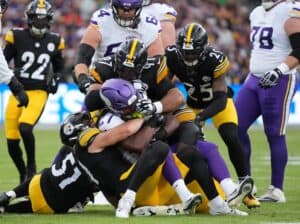
The Steelers must master their fundamentals to stop Miami’s rushing attack
The Miami Dolphins come to Pittsburgh on Monday night riding a four-game win streak that is largely the product of a renewed emphasis on their run game. Miami is averaging 192 rushing yards on their current streak, and they rank seventh in the league in EPA per rush and eighth in rushing yards per game overall.
On the other side of the ball, the Steelers’ defense has done its best impression of a sieve recently. Pittsburgh has given up 249 and 217 rushing yards to the Bills and Ravens, respectively, the past two weeks. With temperatures expected to be in the teens, Pittsburgh can anticipate plenty of runs from a Miami offense that has not thrown the ball more than 23 times in a game in over a month.
What are the keys to Miami’s run game, and how can the Steelers slow it down? Here are some thoughts.
Big personnel
The 11-personnel spread scheme Mike McDaniel rolled out when he first became head coach in Miami is a distant memory. The Dolphins have run 11-personnel on just 40% of their snaps this season, one of the lowest rates in the league. They have run far more 12 and 21 groupings, allowing them to lean on a solid offensive line and two good running backs in De’Von Achane and rookie Ollie Gordon. Achane is fourth in the league with 1,126 yards, and is averaging 125 per game over their current winning streak.
A key player for the Dolphins in their rushing success has been fullback Alec Ingold. Ingold, #30 in the clips below, has been on the field for 35% of Miami’s snaps, a considerable amount for a fullback. The Dolphins like to shift and move Ingold before the snap, lining him up in one spot before relocating him. Between Ingold and tight ends Greg Dulcich and Tanner Conner, the ball is rarely snapped without some sort of pre-snap movement. No matter where these players initially align, one or more will wind up at the point of attack. This is particularly true for Ingold, who serves as a lead blocker on about 80% of his snaps. If the Steelers want to locate the football, just follow Ingold:
One schematic tendency of Miami’s that jumps out when watching film of their offense is how consistently they run behind fullback Alec Ingold (30) when he’s in the game. Ingold played 22 snaps vs the Jets, and served as the lead blocker on a run play about 85% of the time.… pic.twitter.com/St4x8BAYWW
— Kevin Smith (@KTSmithFFSN) December 12, 2025
In order to keep defenses from loading the box to stop the run, the Dolphins often line up in open sets before motioning into a condensed formation. This initially spreads the defense, then forces them to check into a different look to account for the blocker Miami has added to the box. The Dolphins rely on being able to shift quickly to get an extra blocker at the point of attack before the defense can properly adjust. They don’t necessarily care how many defenders a defense puts in the box, so long as they aren’t outnumbered in the gaps they’re attacking. In short, they force defenses to change structure quickly and to remain gap-sound while doing so.
This can be a challenge. As you see in the clip below, the Jets slide over with Miami’s motion, but wind up with multiple defenders outside the B-gap and no one filling from the back side. This creates a huge cutback lane for Achane, who is quickly into the secondary:
Stopping the run will be huge for the Steelers on Monday night vs the Dolphins. Miami is averaging 176 rushing yards over their current four-game win streak.
Two key elements to this for PIT:
1. Run fits
2. TacklingIn this clip from last week vs the Jets, MIA is in… pic.twitter.com/tDhj168yEQ
— Kevin Smith (@KTSmithFFSN) December 12, 2025
Once Achane gets to the second level, he can be tough to tackle. Miami’s running backs have the most yards-after-contact of any backfield in the NFL. And, in those instances defenses do manage to load the box, it doesn’t necessarily slow down the Dolphins. They average 4.5 yards per carry versus eight-man boxes, best in the league. Putting extra defenders at the line isn’t enough. You have to be gap-sound to stop Miami, and you have to tackle.
A run-first culture
Another reason for Miami’s success in the run game is their commitment to blocking at all levels. Their offensive line is good, and their tight ends are willing blockers. So, too, are their wide receivers. The Dolphins often create chunk plays in the run game because their receivers cover up secondary defenders. Simple math does not allow for run schemes to block all the members of a defense. With the quarterback handing the ball off, and the running back carrying it, an offense has two less blockers than the defense has tacklers. That means running backs must make defenders miss to create big plays. But the better wide receivers are at impeding the ability of secondary players to find clean lanes to the back, the greater the odds of those big plays occurring.
Watch here how the Dolphins cover up New York’s perimeter players and give Achane time to find a seam to the end zone. Their commitment to blocking at all levels is one of the most impressive elements of their rushing attack:
Miami’s success in the run game has also been a factor of their downfield blocking.
This TD is another example of the Jets fitting the run poorly — the Sam backer, Mike backer and near safety all fit outside the numbers, with no one filling the cut-back lane — but watch how… pic.twitter.com/nBabdBb8aC
— Kevin Smith (@KTSmithFFSN) December 12, 2025
Fundamentals
For the Steelers to slow down Miami, they must be fundamentally sound. They must communicate well and adjust properly so when Miami shifts they can match numbers at the point of attack. They must maintain gap integrity so Achane doesn’t gash them by finding seams the Steelers have voided. They must get off of blocks, particularly in the secondary, to keep splash plays from occurring. And they must tackle well.
None of it is rocket science. None of it requires a brilliant game-plan. But it does require physicality, teamwork and discipline, all of which have been absent at times for the Steelers.
Can the Steelers summon these things? They’ll be challenged by T.J. Watt’s absence. On the other hand, Derrick Harmon’s anticipated return should provide a boost. Whomever is in the lineup, Pittsburgh’s defense needs to step to the challenge. These are not the Dolphins from a few years ago that shriveled like a delicate flower the moment the weather turned cold. This is a physical unit that tries to pound defenses with the run. The Steelers must be fundamentally dominant to find success.
For more of my work, follow me on X @KTSmithFFSN, and tune into the “Here We Go” podcast every Monday with Bryan Anthony Davis, as well as my “Call Sheet” show every M-W-F.



The Steelers have played three games that were televised nationally so far this season and their record is 0-3. They’ve played poorly on the big stage, losing to the Bengals in Week 7, the Packers in Week 8 and the Chargers in Week 10.
Given the Bengals’ collapse yesterday at home against the Ravens, tonight’s game assumes even greater importance. It’s a home game that the Steelers need to win to maintain their slim margin over Baltimore. Let’s hope they redeem themselves this time on Monday Night Football.