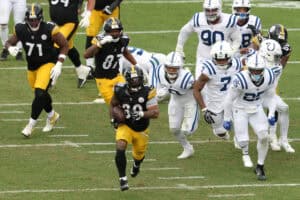
The Bucs game provided more evidence that bigger is better with the Steelers offense
News emerged on Monday that the Steelers had resigned veteran receiver Marquez Valdes-Scantling to the practice squad, who played in five games with Pittsburgh last season, catching 10 passes for 80 yards and a touchdown. Valdes-Scantling will initially join the team’s practice squad but could soon be elevated to add depth to a receiver group that has been depleted by injuries to Michael Pittman, Roman Wilson and Ben Skowronek.
News of the MVS signing shouldn’t move the needle much for the Steelers’ offense. He wasn’t great last season, and at age 32 he doesn’t seem to have much left in his tank. But he wasn’t a great fit for Arthur Smith’s scheme, and perhaps his familiarity with both Aaron Rodgers and Mike McCarthy will carve out a better role for him in this year’s offense.
I mention the MVS signing because I was glad the Steelers didn’t spend valuable resources on a more high-profile player at the position. Adding a veteran to compensate for the injuries at receiver was necessary. But MVS costs them next to nothing, which is about right for a guy who, as a temporary fourth receiver, shouldn’t have much of an impact this year. I say “shouldn’t” because his role will likely disappear once Pittman, Wilson and Skowronek return. But also because, unless DK Metcalf, Germie Bernard or Brandon Smith gets injured or needs a break, the Steelers should minimize their use of spread formations and lean more heavily into their big groupings. That means less 11-personnel, more 12, 13 and 21-personnel. And definitely no 10-personnel.
The argument for the Steelers going bigger on offense is supported by both data and the eye test. Sunday’s game at Tampa Bay provided both. Consider Pittsburgh’s use of personnel and their offensive output in that game:
Steelers personnel usage vs TB:
1st 3 quarters:
11p — 26 snaps
12, 13, 21p — 15 snaps
(3 points, -0.50 EPA per play)4Q/OT:
11p — 14 snaps
12, 13, 21p — 19 snaps
(23 points, +0.27 EPA per play)Bigger is just better for this offense — even when they're trailing.
— Kevin Smith (@KTSmithFootball) October 20, 2026
For reference, -0.50 EPA per play is awful. Tennessee, which has the worst overall average in the league, was at -0.23 entering their game on Sunday. Pittsburgh, operating heavily from 11-personnel, was more than twice that bad over the first three quarters against the Bucs. The Steelers have the worst overall EPA per play from that grouping in the league over six weeks, and it isn’t close.
Conversely, +0.27, which the Steelers averaged in the fourth quarter and overtime when they leaned more into their bigger groupings, is excellent. The 49ers led the NFL in EPA per play entering their game on Monday night at +0.11. The Steelers more than doubled that output in the final twenty-four minutes on Sunday.
Was some of this conditional against Tampa Bay? Not really. The Steelers did fall behind but never trailed by more than ten points through three quarters, which makes their decision to spread the field and chuck the football around seem odd. The irony is they launched their fourth quarter comeback when they went bigger, not the other way around. Going bigger allowed the Steelers to get Tampa out of its nickel personnel and into their base. The Bucs played nickel on 80% of Pittsburgh’s pass plays in the first three quarters. That fell to 47% in the fourth quarter and 57% in overtime, when the Steelers found their most success. They continued to throw the football — they were 72% pass in the first three quarters and 70% pass in the fourth quarter and overtime — but they threw it better against Tampa’s base defense. Pittsburgh’s EPA per dropback went from -0.66 through three quarters to +0.92 in the fourth quarter and overtime.
(1/2) Steelers EPA per pass vs TB:
1st 3Q: -0.66
4Q/OT: +0.92What changed?
PIT went bigger personnel in 4Q/OT and got TB out of its nickel. Bucs ran 80% nickel through 3Q when PIT was heavy 11p. That fell to 51% in 4Q/OT when PIT went bigger.
By keeping TB in its base… pic.twitter.com/Wji6AY0sMT
— Kevin Smith (@KTSmithFootball) October 20, 2026
As for the eye test, I’ll speak for myself. But when I see Darnell Washington and Pat Freiermuth on the field together, the offense feels more capable. This is not a team built for the spread game. They don’t have the receivers for it. Sure, Wilson has promise, but it’s mostly unrealized. Yes, Pittman was a good free agent signing. On paper. Now, particularly, with the wide receiving corps limited to basically Bernard, Metcalf and some street free agents, the Steelers should be heavily invested in their big groupings. Call it identity if you want. Or perhaps just common sense. It’s how this group works best.
The next test for the Steelers is a Saints defense that ranks 28th in defensive EPA and last in points per game (29.7). It could be a big game for the offense, provided they don’t out-think themselves. Bigger is better. They just need to stick to the script.
For more of my work, follow me on X @KTSmithFootball and tune into the “Here We Go” Steelers show with me and Bryan Anthony Davis every Tuesday as well as my “Steelers Chalk Talk” podcast every Thursday at Steel Curtain Network.



Through six games, six being a common base number for some applications of small-sample size statistics, this is what the offense has shown it does best. Can McCarthy and AARod lean into what the data shows them and run the ball more than 33.8% of its offensive plays?!
Beat ’em up with the run, and then pass. It doesn’t mean run every down, but mix the run in more early in the game.
As I mentioned in the snap count article yesterday, they averaged about 1.5 TEs & 2.5 WRs on each offensive snap over the course of the game. To me, that’s not leaning enough into the tight ends in a game without 3 of the top 5 WRs on the team. Is Brandon Smith really better than Pat, Washington, Eli, Wetjen, or Tonyan? That’s the main question I have about the offense and it was answered by you coach.
It’s about Jimmies & Joes, not Xs & Os. Play your better players and not the practice squad guys.
The obvious solution, which I think they did deploy at times against the Bucs, would be to play from 11 personnel when they want to run those sets but to use Friermuth as a WR.
I was shocked to see that Brandon Smith was on the field for 41 snaps (52%) and wasn’t targeted a single time. It seems the whole purpose for having him out there was to try to spread the field. The strategy seemed to be to try to get the ball to Bernard in space and see if he could create YAC. All Bernard’s targets were short passes.
I really didn’t focus on what they were doing with Smith, but that idea definately seemed to be very feast or famine. Other then his TD catch, Bernard had 5 receptions for 13 yards and 5 receptions for 68 yards. It’d be curious to see what was effective versus ineffective there, though one of the shorter gains was the 4th down play which didn’t go for yards but should have been a successful play.
The Steelers only targeted Metcalf once until their last drive of the first half then once on that one and once on the failed first drive of the third quarter. After that he was targeted twelve more times and caught ten passes. All his receptions were short, but they did throw deep at least three times that were incomplete.
I think that definately supports the idea that the personnel sets using their TEs made a major difference. Spreading the field with three WRs wasn’t as effective, given one was just a decoy, as putting five receiving threats on the field that could also block in the run game.