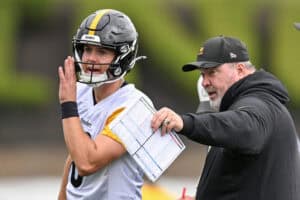
Schematic trends to watch for in 2026, and where the Steelers fit in
As the NFL gears up for another thrilling season, several emerging trends are set to shape the league’s offensive and defensive dynamics. From the resurgence of old-school formations to the evolution of defensive tactics, the upcoming season promises an intriguing strategic battle. Here’s a breakdown of four trends—two on each side of the ball—that are poised to influence the game in 2026, and where the Steelers stand in their use of each.
Offense: Back Under Center and the Rise of the Sail Route
The Return of Under-Center Offense
For decades in the previous century, quarterbacks began most plays under center. This was because the downhill running game was king, and passes were generally seen as an off-shoot of a strong rushing attack.
That perspective changed with the introduction of spread schemes in the early 2000s. As these concepts took over the game, offenses gravitated towards shotgun formations that allowed passing and read-option plays to dominate the landscape.
More than twenty years into the “spread revolution,” offenses are pivoting again. Specifically, they are trending back toward using more under-center formations—not to re-embrace grind-it-out football, but to set up the passing game. In particular, the play-action pass.
Statistics reveal that passing from under center yielded a 30% higher expected points added (EPA) last season compared to shotgun dropbacks. As offenses have gravitated more towards bigger personnel packages in recent years, such as 12 personnel (two tight ends), they have found themselves able to use these looks to lure defenses into expecting a run. That sets up great opportunities to attack them through the air, often with play-action concepts that exploit the defense’s run-first mentality. This approach helps the offense to manipulate defenders, create clearer reads for quarterbacks, and simplify coverage.
The league average for under-center snaps last season was 34.6%. The Steelers were below that average, finishing 18th overall with a 32.5% under-center rate. At his press conference on the opening day of training camp on Tuesday, Aaron Rodgers said he expected that number to increase this season. Playing more from under center should be just one area where Pittsburgh’s scheme, on both sides of the ball, catches up with current NFL trends this season.
The Growing Popularity of the Sail Route
The Sail route is experiencing a surge in NFL playbooks. This classic, user-friendly route combination can be run at every level—from youth football to the pros. Typically, the Sail concept puts three routes at staggered depths (deep, intermediate, and flat) on the same side of the field. The result is a vertical stretch of the defense, often creating enticing high-low reads for quarterbacks, and targeting specific defenders.
There are plenty of software tools out there to fancy up your play designs. But I still like putting pencil to paper and drawing them the old-school way.
Here are some of my favorite Sail designs. Check out today’s Call Sheet pod for why Sail will be a trendy NFL scheme in ‘26: pic.twitter.com/7oVsLRnojD
— Kevin Smith (@KTSmithFootball) July 29, 2026
The NFL’s increased emphasis on zone defenses—especially Cover 3, which was the most frequently called coverage in the league last season (32.9% of all snaps) — makes the Sail route especially potent. Both Cover 3 and the next most popular coverage, Cover 1, are single-high safety defenses that can be attacked via this vertical stretch. The Sail route’s adaptability means it can be deployed from a variety of personnel groupings and alignments, making it a vital go-to play for many offenses.
With Pittsburgh’s depth at the skill positions, I’d expect to see them to run Sail from a variety of formations and personnel groupings. They can vary their looks to create advantageous matchups, whether in terms of scheme or personnel. Sail is also a West Coast staple, meaning Mike McCarthy should lean into it heavily.
Defense: SIMs, Coverage Disguise, and the Split Safety Revolution
Simulated Blitzes (SIMs)
While blitz rates in the NFL have stabilized at around 26% of snaps over the past four years, defenses are innovating by turning to simulated blitzes—affectionately called “SIMs.” Rather than sending more rushers, defenses show multiple threats at the line of scrimmage, then rotate and drop defenders post-snap, often only rushing four. This creates confusion for opposing quarterbacks and offensive lines, making it harder to predict who is rushing and who is dropping into coverage. The result is a sophisticated game of cat and mouse, allowing defenses to generate pressure and force errors without exposing themselves to big plays.
New defensive coordinator Patrick Graham used SIMs frequently in Las Vegas. With better personnel, and the potential for more versatility in his scheme, I’d expect Graham to expand his SIM package in Pittsburgh.
For a deep dive on how Graham may employ SIMs with the Steelers, check out the article HERE:
The Rise of Split Safety Shells
The trend toward more split safety shells—alignments with two deep safeties pre-snap—is transforming defensive play. This tactic makes it harder for quarterbacks to anticipate coverage rotations, as many of these looks morph into single-high safety structures after the snap. Starting in a two-high look and rotating into various coverages enables defenses to disguise intent while minimizing explosive passing plays.
Split safety shells also tie into the growing use of lighter defensive boxes and nickel formations (five defensive backs) throughout the league, enabling teams to mix coverage and maintain flexibility while still protecting against deep threats. Recent Super Bowl champions like the Rams, Eagles and Seahawks have relied on split safety strategies, cementing their place as the defense du jour for teams seeking both versatility and deception.
Graham is a split-safety coordinator and will bring this trend to Pittsburgh. For a look at the structure in general, and how Graham may use it, check out the video below:
One of the takeaways from Steelers’ OTAs is that new DC Patrick Graham will base out of split-safety looks, which is a big departure from Mike Tomlin’s single-high scheme.
Here’s a crash course on split-safety defense, and how the back end will look different this year in PIT: pic.twitter.com/zDohIdBuvQ
— Kevin Smith (@KTSmithFootball) May 22, 2026
The Ever-Evolving Chess Match
The coming NFL season is set to continue the high-stakes chess match between offense and defense. Offenses are re-incorporating under-center schemes and leveraging passing concepts like the Sail route to attack evolving defenses. In response, defenses are disguising their intentions with simulated blitzes and split safety shells, challenging quarterbacks to diagnose correctly in real time.
As each side adapts, the strategic balance shifts, keeping football fans on the edge of their seats. Expect these trends to define much of the tactical conversation in 2026—cementing football’s place as the ultimate cerebral showdown on the gridiron.
I’ll be at Steelers training camp on Friday and Saturday of this week, so stay tuned here at SCN and follow me on X @KTSmithFootball for plenty of news, analysis and updates.



a true Pittsburgh Steelers fan, since the 70’sthe Steelers have two chess pieces on the Steelers offense Darnell Washington and Eli Heidenreich
Good content with the Sail! Keep putting up more of this information. I didn’t play football, so some of these concepts and lingo are new to your listeners