One statistic that could suggest improvement for the Steelers offense this season
“There are three kinds of lies: lies, damned lies, and statistics.” — Mark Twain
Statistics have always fascinated me. When I was a kid, I kept a notebook that recorded the batting averages, home run and RBI totals of my favorite baseball players — guys like Jim Rice, Dave Parker, Mike Schmidt and Andre Dawson. I would study the press boxes from the sports’ section of newspapers, no matter the team or sport. If a friend asked me at school how many rebounds Moses Malone had the night before, or how many yards Walter Payton had rushed for on Sunday, I knew the answer. It was a way of keeping track of who was doing well and who wasn’t, I suppose. Or maybe of organizing sports in my head in a way that made sense.
Statistics have evolved greatly since the days of those rudimentary box scores. “Advanced metrics” can now give you the exit velocity of a baseball as it leaves a hitter’s bat, or the top speed a running back reaches as he sprints towards the end zone. In football, acronyms like DVOA, EPA and PRWR have replaced simpler statistics like total yards and sacks as the go-to metrics of stat nerds and talking heads. Quarterback Rating (QBR) uses a formula so convoluted in determining effectiveness at that position that a perfect rating is 158.3. Only in the world of statistics is 158.3 a perfect score.
I’ve learned to take statistics with a grain of salt. Maybe it was 30 years as a government and politics teacher, where I realized politicians treat facts as suggestions, and that statistics are merely tools they use to manipulate their version of the truth. Seventy-eight percent of statistics are made up, after all.
(Wink).
I did come across a statistic the other day that caught my attention. It was posted on X by Matt Williamson, who does a great job of analyzing the Steelers through numbers. Here’s the tweet:
In all five years as Dallas Head Coach, Mike McCarthy’s offenses ranked Top 8 in plays run per game#Steelers
— Matt Williamson (@WilliamsonNFL) June 25, 2026
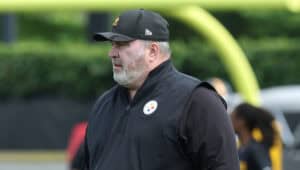
On the surface, there’s an obvious “good” there. If Mike McCarthy’s offenses finished Top-8 in plays-per-game every year he was in Dallas, it stands to reason he’ll function similarly in Pittsburgh. More plays equals more opportunities to move the football, and also suggests drives are being sustained. The Cowboys led the league in first downs per game in 2023, and were sixth in that category in 2020 and 2021. Ideally, it should equate to better offense in general, and more points in particular.
When I saw Matt’s tweet, I thought back to a comment McCarthy made to the media during mini-camp. It seemed like a remark of little importance at the time, but it makes more sense now. McCarthy said he wanted the offense to get out of the huddle quickly and get lined up on the ball as fast as possible. There could be plenty of reasons for stressing this, particularly as a new coach taking over an offense. Maybe McCarthy wants to create a sense of urgency. Get in and out of the huddle fast. Hustle to the line. Be crisp. Maybe he doesn’t want the opposing defensive coordinator to have as much time thinking about his call and barking instructions into the headset of the player wearing the green dot for his unit. Maybe he wants to play at a fast tempo.
Or maybe it’s more calculated than that. With Aaron Rodgers at quarterback, McCarthy has a player who has seen everything a defense can throw at him. There will be few surprises, whether before of after the snap. The faster the offense gets to the line, the more it benefits a veteran like Rodgers. An offense that’s slow in its operation and gets to the ball with just six or seven seconds remaining on the play clock has no choice but to run the play called in the huddle. There simply isn’t time at that point to look at the defense, adjust the formation or the call, and get into something more advantageous.
If the offense gets its call in quickly though, and is in and out of the huddle in a timely fashion, the defense must respond in kind. This means less time for them to change personnel, less instruction from the DC to the green-dot, and more time for Rodgers to examine their pre-snap structure and make adjustments. I don’t know how much leeway McCarthy will give Rodgers to change plays at the line. But I’d be shocked if he doesn’t have options at times on where to go with the ball.
Here’s an example. Perhaps the Steelers will line up in a 3×1 set where the play-call pairs an inside zone run with a perimeter screen to the trips. On the back side, they’ll have an option to throw some sort of Choice route to the single receiver. Rodgers gets to the line, scans the defense, sees they’re playing two-over-three to the trips, and throws a quick screen to Germie Bernard. Or maybe they’re three-over-three with a safety shaded over the backside receiver and the numbers are equal in the box. Then Rodgers hands the ball to Jaylen Warren or Rico Dowdle on the zone run. If he gets true single coverage on the back side, he opts for the Choice route to DK Metcalf.
The point is, a crisp operation allows for this sort of flexibility. To make it happen, McCarthy has to communicate his call from the sideline quickly. As a veteran coach with over twenty years of experience as a play-caller, McCarthy should have a good idea of what calls he wants in various situations, and where to find those calls on his play sheet. This seems like a minor thing, but with how verbose some calls can get, there’s nothing more frustrating for a coordinator than knowing what you want to run but wasting time on the play-clock trying to locate it on your call sheet.
Once the call is in, Rodgers must have a sense of urgency relaying it in the huddle, and the players must hustle to the line. This is something a team can — and should — model in practice repeatedly until it becomes second nature.
The Steelers had a few of these play packages in their scheme last season, but the execution was spotty. Often, Rodgers and the receivers were not on the same page. Some struggled with alignment issues, others with post-snap responsibilities. McCarthy’s history suggests improvement can be expected.
We won’t see these types of calls on every down, of course. If the Steelers simply want to play fast, they can call a play, get in and out of the huddle and run it. Varying tempo is a nice way to keep a defense off-balance. A quick huddle operation will provide this option as well.
Not all statistics carry equal weight, but the number of plays a team runs can reveal a lot about their operation. For the Steelers, improvement in this area could really open up the offense.
For a deep dive into the X-and-O’s of the Steelers, tune in to my “Chalk Talk” podcast every Thursday at 11 AM. This week’s topic is on why Jalen Ramsey may be the team’s most important player on defense this season.


