My opinion of their opinion: Breaking down the Steelers individual PFF scores from the first half of the 2026 season
Several seasons ago, I decided to switch up how I report the grades by Pro Football Focus (PFF) because of my frustration due to the all-to-often absurdity of their findings. Instead of listing out all the scores, I gave highlights of some of the highs and lows and whether or not I thought their grading passed my own eye test. Since it seemed to be the most receptive approach, I decided to make this a weekly thing where I give my opinion of the PFF scores.
As always has to be the case when PFF is mentioned, the disclaimer is these grades are subjective and merely the opinion of those doing the evaluation. While PFF looks at every player on every snap, they are still simply forming an opinion of what they believe that player was supposed to be doing that play in order to determine if they were successful or not. They give maximum effort based on the information they must assume, but it does not mean their assumptions or conclusions are correct.
So here are my overall impressions of the scores from the Steelers over the first half of the NFL season with my grade of PFF at the end.
Offense
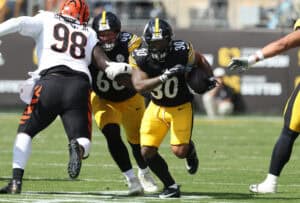
The top overall score for the Steelers on offense through the first nine weeks of the season is not really a surprise as Jaylen Warren leads the way with an 87.3 overall score. Warren has a team-high 91.1 running score as well as a 71.8 receiving score. His overall score is ranked 4th among 62 qualifying running backs.
The only other score in the 80s for the Steelers offense belongs to Darnell Washington with an 80.3 overall, 3rd out of 73 qualifying tight ends. Washington’s score comes from a composite of solid numbers of 76.5 receiving, the high score on the Steelers team, as well as a 66.1 pass blocking score and a 72.9 run blocking score.
Just missing the 80s is Zach Frazier with a 79.5 overall score which is first among 36 qualifying centers. Frazier has a 76.3 pass blocking score and a 79.8 run blocking score on the season.
There are two other scores in the 70s for the Steelers in Dylan Cook (76.4) and Mason McCormack (76.1). While many Steelers fans were quick to replace Cook, he was the top-graded offensive lineman at the time. But rookie Max Iheanachor has helped to spark the Steelers offensive line despite a 64.1 overall score which is 43rd out of 71 offensive tackles. As from McCormick, he ranks 14th amongs 75 guards.
At the bottom of things, there are two players who scored below a 50.0 overall but do not have enough snaps to qualify for ranking at their positions. Lew Nichols has a 44.0 overall score based mainly from a 14.1 pass blocking score despite having a 59.7 rushing score. The other score below a 50 is fullback Riley Nowakowski with a 45.9 based primarily on a 25.8 receiving score despite only playing two receiving snaps this season.
When it comes to individual statistics, when not looking at it game by game, passing and receiving are separated out into separate categories. Aaron Rodgers leads the team with a 63.8 passing score with Mason Rudolph 60.5 is the only other qualifying score. Rodgers overall score of 65.2 is 24th of 36 quarterbacks.
As for receiving, after Darnell Washington’s 76.5 the only other score in the 70s was Jaylen Warren 71.8. The next highest score after that is Brandon Johnson with a 65.7.
When it comes to running, it’s expected that Jaylen Warren’s 91.9 is top but the second score belongs to Pat Friermuth with a 79.5 followed by Aaron Rodgers with a 74.2. Rico Dowdle comes in fourth with a 64.4.
As for blocking, Riley Nowakowski has the top pass blocking score for the Steelers at this time with an 80.5 followed by six players scoring in the 70s. Those include Pat Freiermuth (78.1), Zach Frazier (76.3), Dylan Cook (73.7), Travis Homer (73.4), Robert Tonyan (72.2), and Troy Fautanu (70.8). For run blocking, after Dylan Cook’s leading score of 81.4 comes Zach Frazier (79.8), Mason McCormick (77.3), and Darnell Washington (72.9). It should also be noted that wide receiver Marquez Valdez-Scantling does have a 79.1 blocking score but it was not from games with the Steelers as he has not suited up for the black and gold this year.
Defense
The top score overall for the defense belongs to Jamel Dean with an 83.1 overall. Dean has a team-high 93.9 run defense score to go along with a 73.9 coverage score. Dean is currently ranked 5th out of 104 qualifying cornerbacks.
The next highest score on defense belongs to T.J. Watt with an 81.9 overall ranking him 10th out of 110 edge rushers. Watt has a 90.9 run defense score but only has a 65.8 pass rushing score to go along with a 69.8 coverage score.
The Steelers have six other defenders ranked in 70s at this time. Cam Hayward is just out of the 80s with a 79.2 which ranks him 7th out of 126 defensive linemen. Other scores and rankings in the 70s include Robert Spears-Jennings (78.7; 9th of 110), Keeanu Benton (76.2; 12th out of 126), Alex Highsmith (75.1; 21st of 110), Payton Wilson (71.8; 16th of 79), and Daylen Everette (70.8; 18th of 104).
Much like the offense, there are only two scores below a 50 and they belong to players who do not have enough snaps to qualify for ranking at their positions. Brandin Echols has a 43.8 overall score based mainly off of a 39.9 coverage score. Gabriel Rubio has a 44.2 overall score based on a 38.6 run defense score.
When it comes to specific scores, after Jamal Dean and T.J. Watt scoring in the 90s in run defense, Payton Wilson is close behind with an 87.2. Other scores in the 70s include Jaquan Brier (78.1), Robert Spears-Jennings (75.9), and Daylen and Everette (70.8).
As for pass rush, Derrick Harmon has the top score from his action before landing on IR with an 84.2. He has followed by Keeanu Benton (74.2), Alex Highsmith (73.7), Jalen Ramsey (72.5), Cam Heyward (71.1), and Patrick Queen (70.7).
Coverage scores are quite interesting with the top scores going to outside linebackers. Nick Herbig has the top coverage score with a 79.9 followed by Jack Sawyer with a 79.1. Alex Highsmith rounds out the top three with a 75.1 followed by the first player in the secondary of Robert Spears-Jennings with a 74.0. Wrapping up the rest of the scores in the 70s are Jamel Dean (73.9) and Cam Heyward (70.7) on three coverage snaps. Just missing the 70s was T.J. Watt (69.8) and Daylen Everette (69.6).
Overall
To give a quick update on special teams, the Steelers have three high scores by Jack Sawyer (85.6), Payton Wilson (83.3), and Robert Spears-Jennings (81.5). There are two scores at the bottom end in Terrell Smith (38.1) and Ben Skowronek (29.8).
I was going to break down the team scores for the Steelers in this section, but decided that would be best for a separate article which will be becoming soon.
When it comes to evaluating these scores, they get much better when looking at the entire season. Where things don’t look great is when players who don’t have many snaps have particularly low scores. A prime example is Gabriel Rubio who has only played 70 snaps this season and I feel has done a very nice job as the Steelers have completely shut the run game down of their opponents since Rubio has gotten a helmet. Yet his score is quite low.
Offensively, I’m not going to argue the overall scores very much as players who have been inconsistent or just not high-quality are getting scores hovering around the 60.0 mark. The players who are getting the majority of the snaps are the ones that are turning in higher scores as there are only two players on the Steelers offense with overall scores below a 60.0 who actually qualify to rank at their positions in DK Metcalf (59.9; 87th of 120) and, surprisingly, Michael Pittman (50.5; 115th of 120).
On defense, I already mentioned I’m not big on Gabriel Rubio having such a low score. I was also surprised to see Asante Samuel Jr. at a 57.3 overall with a 58.8 coverage score and ranked 69th of 104. At the same time, Samuel did not have that great of scores early in the season but has turned in much better scores over the Steelers four-game winning streak. Samuel was the only player who qualifies for a ranking on the Steelers defense that does not have a score of at least a 60.0.
The more data that is out there for a player, the less outlying miscalculations affect them. In all honesty, I think the season-wide scores much better reflect what a player is doing than the ones that come game by game.
My grade of this week’s PFF scores: B