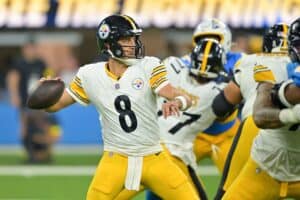
Is Aaron Rodgers still capable of executing a vertical passing game?
With training camp just a week away, it’s time to dive in on some of the most serious questions the Steelers must answer in order to be successful in 2026. Let’s call this our “QOD” series: Question of the Day. Today’s query concerns the vertical passing game in Pittsburgh. In short, is Aaron Rodgers still capable (and willing) to execute one?
One of the most telling statistics about Pittsburgh’s offense last season involved Rodgers’ air-yards-per-completion number (AYPC), which was 2.4 yards. That means the football traveled just 2.4 yards in the air on average on completed passes. You don’t have to know much about football to know that’s not very far. In fact, it was the shortest average in the league last season among starting quarterbacks.
Pittsburgh’s reliance on such a short passing game hamstrung the offense. Explosive plays were harder to come by, and without explosives, scoring points was a bigger challenge. The Steelers did manage to finish 15th in the league in both explosive play percentage and in total points, which is almost shocking given their lack of a vertical passing attack. With a more aggressive passing game, they easily could have been a Top-10 team in both categories.
Rodgers’ meager AYPC number leads us to a chicken-and-egg type question: was the figure so small because Rodgers was unwilling to stand in the pocket and target deeper developing routes? Or, was it because Mike Tomlin and Arthur Smith designed the offense that way? Or was it perhaps another factor, like a young and inexperienced line that couldn’t provide Rodgers enough time in the pocket to target those deeper routes?
The answers to those questions are tricky. All three played a role in one form or another. But, having watched plenty of film from last season, I lean towards the pass protection as the biggest culprit.
It’s true there were countless examples of Rodgers unloading the football far too quickly. Often, he’d catch the snap, peek at the first read in his progression, and if it wasn’t open, immediately dump the ball to an outlet receiver before the pass rush could threaten him. It’s been like that with Rodgers for awhile now. Just look at the tweet below, which examines a passing distribution chart for from one of his games in Green Bay in 2020:
Aaron Rodgers relied on quick, short passes in tonight's 24-16 win over the Panthers.
➤ 2.37 average time to throw*
➤ 4.5 air yards/attempt**Quickest & shortest in a game by Rodgers in the NGS era (since 2016).#CARvsGB | #GoPackGo pic.twitter.com/9BXGC3mwUI
— Next Gen Stats (@NextGenStats) December 20, 2020
AYPC has only been a statistic since 2018. But in those eight years, Rodgers has annually posted a low number. It was between 3.4 and 3.9 from 2018-2023, which was near or below league average, then dipped to 3.0 in 2024 and 2.4 last season. The past two years, he’s been 30th and 32nd among starting quarterbacks in AYPC. The numbers don’t lie. As Rodgers has aged, he’s relied increasingly on short, quick throws.
But that hasn’t simply been a product of not wanting to get hit. Rodgers’ average time to throw, meaning the time between when he receives the snap and the ball is out of his hands, has declined as well. Rodgers had the third-fastest time-to-throw of 46 qualifying quarterbacks in the league last year at 2.48 seconds. Again, short throws have factored into this. But so has the quality of his offensive line play, which was not stellar the past two seasons in both New York and Pittsburgh. While Rodgers pressure rate of 22.8% was one of the lowest in the league, it was less a factor of good protection and more a product of the rush closing in quickly and Rodgers rapidly distributing the ball as a result. This was particularly true early in the season, when Pittsburgh’s young offensive line was just learning to play together.
Where things get interesting, though, is in those instances where Rodgers was provided a clean pocket from which to throw. There are several examples from later in the year where the vertical passing game picked up as the protection improved. The Miami game in Week 15 provides a couple of solid examples. On this first throw, Rodgers is given a clean pocket and has time to set his feet, look at the first receiver in his progression, then re-set and hit DK Metcalf with a strike that splits the safeties. This is precisely the type of throw Steelers fans have been clamoring for since Ben Roethlisberger retired:
There aren’t many clips of PIT’s offense last year like this one, but they exist.
Rodgers calm in the pocket, not rushing the ball out of his hand, going through progressions and finding Metcalf between the safeties.
The success of the pass game will be tied to the protection. pic.twitter.com/gDQjR6Cl4K
— Kevin Smith (@KTSmithFootball) July 20, 2026
Later in the game, we see another example, with the Steelers at the edge of the red zone. They run a play-action pass on 1st-down, catching Miami in single-high coverage. The play fake holds the linebackers, and the mesh concept where Metcalf and Marquez Valdes-Scantling cross each other conflicts the safety. The safety is late in reacting, and MVS beats him on the deep over route for a touchdown:
Another example of Rodgers targeting downfield when given time. Checkdowns are open but the clean pocket gives him access to the deep over.
I don’t think the narrative that Rodgers doesn’t want to play vertically is true. It’s more about the protection (and scheme) letting him. pic.twitter.com/ZQwka5rdIH
— Kevin Smith (@KTSmithFootball) July 20, 2026
Look at how long Rodgers holds the ball on this play. In real time, it’s nearly four seconds from snap to throw. Rodgers has both of his checkdown routes available, but with ample time in the pocket, he’s able to target the deeper-developing route.
It’s no coincidence Pittsburgh’s explosive play rate increased late in the season as the young line improved. Compare the two passing charts below. The first is from Week 4 of last season, which was Pittsburgh’s game against Minnesota in Ireland. Rodgers was extremely efficient in that game, throwing for 200 yards on just 22 attempts. But the passing attack was littered with perimeter screens and short throws. Some of these were in response to Brian Flores’ blitz-heavy scheme. Many, though, were the product of Rodgers not trusting his protection, and a scheme that accommodated this fact:

Later in the season, as the line improved, Rodgers was able to get more aggressive. The Miami game in Week 15, the Detroit game in Week 16 and the season finale against Baltimore all showcased an aggressive vertical passing attack. You can see from Rodgers’ spray chart in that Ravens’ game how much the philosophy had changed:

Grated, Minnesota is a blitzing defense with an aggressive pass rush and Baltimore had one of the worst pass rushes in the league, which allowed Rodgers more time in the pocket. The point is, when given time to throw, and the confidence he could get to his deeper progressions, Rodgers was willing to do so.
Final point about the pass protection: I don’t like to single out individual players as clear weak spots, but Dylan Cook’s insertion into the lineup at left tackle in place of an injured Broderick Jones played a big role in the evolution of the passing game. Jones struggled miserably in protection last season, to the point where Rodgers was anticipating pressure from his blind side and hurrying the ball out of his hand as a result. Cook’s protection in both of the clips above was in line with his protection in general: rock solid.
Will we see a more vertical passing attack from the Steelers this season? Your guess is as good as mine. But I suspect we will. The line will be better, the philosophy should be more aggressive, and Rodgers has better weapons to work with. I wouldn’t expect the unit to morph into The Greatest Show on Turf any time soon. But I do expect to see the team push the ball downfield much more aggressively than they did a year ago.



a true Pittsburgh Steelers fan, since the 70’s I don’t think so Aaron Rodgers is passed his prime Drew Allar, Will Howard, and Mason Rudolph is the better choice
I had big questions about the O line at the end of the season, and still think it is a big fat unknown today. I like the coach and moving Fautanu and McCormick to the left and I like Cook as the starter, but I’m far from ready to say this is the O line of the future. They have a lot to prove, but I like the moves made thus far.
I’m with you. To me, the first few games will feel like trial by fire and hopefully the line can keep Rodgers upright and uninjured while they (hopefully) improve.
I felt like last season (and Rodgers’ prior with the Jets) was the perfect example of an aging QB trapped in a depleted offense. I firmly believe the dude still has it.
Forgive the reference, but Tom Brady spent his last couple of seasons with an underwhelming O-line and considerably less talented weapons. “Washed” was being thrown around even though his numbers weren’t all that bad. Then he lands in TB with Bruce Arians and the 43-year old lights it up.
I am not suggesting Rodgers (who is no Tom Brady) will have a season like that, but the conditions will be more favorable, and so I anticipate seeing a difference: more passing attempts, a higher % of intermediate/middle of the field throws, less dependence on heavy personnel, more passing TDs.
He isn’t gonna be scrambling around and his deep ball isn’t going to get more accurate, and the Steelers are not suddenly going to be a top 10 offense. Hell, we may not even see a significant rise in average yards per attempt when it’s all said and done, but yes indeed, we will see a more vertical game.
I’ll be stunned if by some miracle he’s routinely holding onto that ball and tossing it 20-plus yards downfield like in his prime Green Bay days. Deliriously happy, of course, but stunned nonetheless.
Look at all the passes behind the line of scrimmage. How much of that is Rodgers going to his check-down and how much is it the design of the play? Id be interested in seeing how often the Steelers pass behind the line of scrimmage compared to other teams, though I feel like there was an analysis of that here a while ago.
There’s no easy way to tell on the first part, whether they were designed plays or checkdowns without film review, as far as I know.
But I can give you info on the second part. Three players on the Steelers accounted for 41.4% of the teams receptions – Warren, Gainwell and Jonnu Smith.
Here are their Yards Before Catch (YBC) averages:
Warren: -0.6
Gainwell: -2.7
Smith: 1.1
So the weighted average YBC (equivalent of AYPC) of those three players was -0.7. That’s negative 0.7 yards per catch. I can’t say how that compares to other teams, but 41% of your passing going about 1 yard behind the LOS seems pretty high..
Insteresting side note, Kevin mentioned the Steelers were 15th in Explosive plays. A lot of that may have been Warren. His Yards After Catch was a ridiculous 11 yards and his catch percentage was at 89%. I would expect that a lot of that was dump offs that he turned into more yards then expected, though possibly not for 1st downs if the team was third and long.
And, if I had to guess on your first ask, I’d say the bulk of Smiths catches were around the LOS and were set plays, the bulk of Warrens were likely dump offs and Gainwell, who led the team with 73 receptions probably had a mix of both.
So maybe 50% of their short game was planned, 50% was check-downs.
That would indicate that around 20-25% of their passing game was scripted passes near the line of scrimmage. That may be closer in line with other teams but still could be a higher then average.
The use of Jonnu Smith last season was baffling. Arthur Smith is a damn good football coach, but I’ll never understand his plan for Smith last season, or why he was so enamored with it.
It really was. I know they thought he was going to be a weapon but it became pretty clear that he wasn’t who he was the previous season.
Bingo. Mike Tomlin’s aversion to turning the ball over is well-documented. While, all coaches naturally want their teams to minimize turnovers, Tomlin seemed to take things to another level, ie. benching good players for fumbling the ball one time.
I don’t have the knowledge base to prove it, but I wouldn’t be surprised at all if the offensive design was intentionally constructed to throw it short to reduce giving the ball away. What we see this year will almost certainly shed some light on things.
I honestly don’t think this was a Tomlin thing specifically. I think it had to do with a lot of factors but the two biggest were A.Smith and Aaron Rodgers who had different ideas on how an offense should be run, but also had line issues to deal with.
You can be risk-adverse and still keep other teams off balance. Tom Brady was a master at that. His offenses always looked so easy to execute. The Steelers, by contrast, seemed to struggle on every play.
If anything, Tomlin likely looked at what his team could do realistically and worked with Smith to mitigate failures. That’s not really the same thing as being risk-adverse as much as being risk aware.
Perhaps, but the crazy conservative offense wasn’t relegated to just last year, though. To me, it all began with the hiring of Matt Canada and following with Matt Canada V2, Arthur Smith. I don’t know the specific numbers but I seem to recall Ben’s last year or two focusing on a short passing game followed of course by the Trubisky, Pickett, Fields, Wilson, Rodgers parade. The names all changed but the short game remained.
That’s two different OCs and 6 different QBs all with, generally, the same result. I am not a Mike Tomlin basher but he is the only consistent there.
It’s 100% conjecture on my part but I tend to believe that Mike Tomlin, perhaps wisely, knew that his offenses of the past few years weren’t very good. The only way to win with them was to minimize turnovers and the best way to do that is to not take risks to begin with.
There is definately evidence that routes were shortened to try to get the ball out quicker in the Steelers offense, though another factor could be that Rodgers was just far less accurate when throwing deep.
I posted some data in another comment about the running backs and Jonnu Smith who received an inordinate amount of attention in Smiths offense.
But another guy to look at is Metcalf. He was targeted 99 times out of 522 targets, almost one in every five passes and he caught 59. His average depth of target dropped 2.6 yards and his Yards Before Catch dropped 3.6 yards. Those are pretty big declines and both were the lowest of his career.
One of the issues that resulted in was that Jonnu Smith, who many thought might have a big impact on the offense, ended up being completely nullified. For him to be effective like he was in Miami required stretching the field with a vertical game and him being able to take a short pass and get Yards After Catch.
But the shorter routes being run by a guy like Metcalf made Smith less effective and A. Smith, who sill wanted to use him, resorted to throwing him lots of screen passes. Essentially, Metcalf took over what Smiths role was supposed to be, but with no one stretching the field to create space for him. At times it worked, but other times there were a lot of forced passes and contested catchs which were not his strength.
Hopefully, the Steelers will use Pittman, Freiermuth and Washington to run a lot of those underneath routes this season so they can get back to allowing Metcalf to operate further down the field.