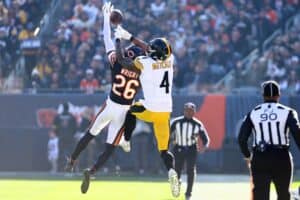
For the Steelers passing game to improve, they must create more separation for their receivers
I came across an interesting statistic yesterday that confirmed what many Steelers’ fans probably thought last season, but didn’t have the data to validate:
Pittsburgh’s receivers struggled to get open.
It feels like this has been a recurring theme for years now. Using the eye test as a barometer, Pittsburgh’s quarterbacks, no matter who’ve they’ve been recently, constantly seem to be throwing the ball into tight coverage. Yesterday, in a chart posted on X by @NutshellSportz, I found the evidence I’d been looking for:

The chart maps team separation per route adjusted for depth. Or in simpler terms, it shows how much space a team’s receivers generate relative to the distance of their routes. It then measures that space to the league baseline to determine how much separation each team’s receivers achieved.
In the case of the Steelers, the answer is not much.
Pittsburgh finished 25th in separation versus expectation last season, with a measurement of -.20. Why did it look like Aaron Rodgers was constantly throwing into small windows? Because he was. Rodgers did a nice job of minimizing turnovers despite this, throwing just eight interceptions. But the fact the Steelers struggled to create separation in their routes hamstrung the passing game. This is especially true when you consider Rodgers had the lowest air-depth-to-target number in the league, meaning he threw shorter passes than any other quarterback. Shorter routes are easier to create separation on because of the cushions usually provided receivers at the snap. So, while the Steelers went heavy on routes that should have yielded wider separation, they still finished in the bottom quarter in the league in creating it.
Why was that? In part, it occurred because they lacked dynamic receivers. DK Metcalf, the team’s top target, has never been a player who separates comfortably from coverage. Metcalf often uses his strength and brawn to shrug off defenders rather than his fluidity and route-running ability. This can still be effective, but it limits separation. Calvin Austin III could occasionally run by cornerbacks, but his size made him susceptible to being jammed at the line of scrimmage, limiting his ability to get open. The rest of the team’s receivers were older, slower, or in the case of Roman Wilson, deficient in other areas. More on Wilson in a moment.
The early struggles of the offensive line to protect Rodgers factored in as well. While the line improved as the season progressed, Rodgers was under pressure a lot early on, which forced him to unload the football quickly. Defenses soon began to crowd the line of scrimmage to take away easy throws, and it became harder to separate. Rodgers’ unwillingness to stand in the pocket and let routes develop downfield, particularly against zone coverage where receivers can find space in the intermediate areas of the field, also affected the separation numbers. Mike Tomlin’s resistance to attacking these areas aggressively contributed as well.
For the passing game to improve in 2026, Pittsburgh’s receivers will simply need to do a better job of getting open. How might they? To begin, the Steelers need to integrate more play-action passing into the offense. Play-action is a great way to scheme receivers open because it displaces a defense with the run fake. Defenders who initially react to the run have to scramble to get back into their zones, often leaving voids that can be exploited. The Steelers ranked 27th in play-action frequency last season, at just 13.1% of their play calls. That likely contributed to their low separation rate. By contrast, the Bears, who led the league in separation rate, were 2nd in play-action frequency. The Bills were sixth in both separation and play-action use. The Broncos were fourth in separation and seventh in play-action. Chicago, Buffalo and Denver all had solid receiving corps, but none were elite. It’s not a coincidence. The play-action game is beneficial in creating space.
Then there are the receivers. The Steelers clearly upgraded the position group this off-season. Free agent signee Michael Pittman Jr. is a crafty veteran who knows how to work coverage. He won’t run by defenders, but at 6’3-215 he won’t get knocked around on his release either. Rookie Germie Bernard is another player whose size (6’1-206) and strength will benefit him as he navigates coverage. Bernard is excellent with the ball in his hands and becomes an immediate candidate to run Pittsburgh’s perimeter screen game. With big teammates like Metcalf and Pittman out in front blocking, the YAC possibilities seem greater this season.
I mentioned Roman Wilson earlier. Wilson has consistently shown he can create separation when he’s on the field. That last part is key. Can Wilson establish himself as a part of the rotation this season? If so, he will give Pittsburgh a shifty receiver to pair with the physicality of Metcalf, Pittman and Bernard. He may be the best big-play candidate on the roster, which is important for a Pittsburgh offense that finished middle-of-the-pack (17th) in explosive play rate last season.
Another thought on WR separation for PIT:
They have to find a bigger role for Roman Wilson (10).
Wilson needs to improve on his craft overall. But whether it’s beating press coverage, adjusting to off-platform plays or finding space on rubs and iso routes, Wilson gets open. pic.twitter.com/CdnozidUgW
— Kevin Smith (@KTSmithFootball) June 15, 2026
Tight end Pat Freiermuth could be a key to generating separation as well. Freiermuth’s role diminished last season under Arthur Smith. With McCarthy running the offense it’s likely the Steelers will attack the middle of the field more often, where tight ends can find space to operate. McCarthy liked Jake Ferguson in that role in Dallas. Ferguson had 188 combined targets in his two seasons with McCarthy. Meanwhile, Freiermuth received just 132 targets the past two season with the Steelers.
Finally, with an improved offensive line whose young core has gained a year of experience, the pass protection should improve. Hopefully, that will incentivize Rodgers to stand in the pocket a bit longer and allow those in-breaking and intermediate routes that often yield receiver separation to develop.
More play-action passing. An improved receiving corps. A more aggressive play-caller. A better line. And (hopefully) a quarterback willing to use the full field. The recipe is there for receivers to get open and to produce an improved passing game in 2026.
For more on the X-and-O’s of the Steelers, join me every Thursday at 11 AM for my Chalk Talk podcast. This week, we examine how Patrick Graham marries his scheme to his personnel, and how that might play out in Pittsburgh.



Is this a Chicken or the Egg situation? Were guys not getting open because they can’t get separation or because of what the Steelers were running would let them get open? I guess this is the reason I am very interested in the 2026 season. It is all unknown. As much as I liked Tomlin and as good as he was, I really believe that to quote Mike T he became a victim of living in his fears. Everything became so conservative on both sides of the ball that he got to the point that winning games 13-10 with a defensive TD was preferred.
I have a lot of hope that Rodgers will be a better player in his second year with the team. I also think everything around him is better on offense and that the defense should also be a few ticks better.
I think it’s the chicken AND the egg (if that’s a thing). There were definitely scheme issues last year, and I’m encouraged by some of what I’ve seen from McCarthy in DAL. Here’s some of the stuff I’m hoping to see him being to PIT:
https://x.com/ktsmithfootball/status/2066887467425292663?s=46&t=dBDtyHKLy_Bxp4Thg9ktew
I don’t know if that chart really proves much of anything. The Saints were 3rd best and the Rams were 5th worst, but I don’t think anyone was afraid of the Saints and taking it easy on the Rams. As you kind of mentioned there Coach, those numbers are greatly influenced by other factors like the general scheme of a team. I would also think that the QB factors into those numbers as well. If Burrow was healthy the whole year, the Bengals probably wouldn’t be 3rd worst on that chart. It’s an interesting take, but I don’t know if “Team Separation Adjusted for Average Route Depth” will take advanced analytics by storm there.
Hey for advanced analytics the more confusing the stat is the more it is to those in that camp. When pass rush win rate means more than sacks it tells you everything you need to know.
It tells you the system is basically BS
These are good points. I thought the Cincy spot was interersting as well. I’m not sure I understand the chart itself. Was this on passes thrown by the QB or on all routes run by the receivers even when not targeted. If it’s the latter, the QB shouldn’t matter unless the team was calling plays differently and that doesn’t seem likely given that Flacco was the QB. However, if it’s the former, which seems likely, then the QB definately matters and that’s specifically relevant to the take for the Steelers.
If the Bengals are down so far primarily because they replaced a younger more mobile QB who could wait for a split second for the receiver to come more open with an aging, less mobile QB who used his experience to try to throw a receiver open, then the number could easily be skewed by the QBs playing style.
That’s relevant for the Steelers because of how quickly Rodgers threw the ball and to whom he threw it to. 19% of the Steelers targets went to Metcalf, a known non-seperator but the guy Rodgers seemed most comfortable targeting. Another 16% went to Gainwell, coming out of the backfield. I’d be curious to see the seperation stats by target. Did Gainwells targets improve the seperation figure or make it worse? The chart says its weighted by targets. I’m not really sure what that means as it relates to the metric but, generally, that would mean that Metcalf’s stats are given more importance relative to other receivers.
But back to Rodgers. If, as the play caller, it was on him to decide who was open and he often chose the guy who was less open that he was more comfortable getting the ball out quickly to, then, I’d agree that he is a primary influence on the metric.
And there is some ancillary data that might back this up. A few weeks back there was an article I was commenting on about Roman Wilson and Rodgers targeting of rookies. Someone had pointed out that Rodgers had no problem targeting rookies in Green Bay (including I beleive Doubs and Christian Wilson). At the time, I looked at Rodgers advanced passing stats in 2022 compared to 2025 and noted that those stats supported the idea that Roders was pressured less under QB for the Steelers then he was in 2022 in Green Bay but that his pocket time was about 0.2 seconds shorter last year then it was in 2022. That suggests that Rodgers was willing to hold the ball longer back then to let a route develop and a receiver come open then he was in 2025. That could easily affect this metric.
That’s the big concern I have going into this year. Rodgers is a year older and the line is going through another set of transformations. It seems like, at least initially, Rodgers will be looking to get rid of the ball, possibly even earlier then last year. This is where play calling will be crucial. Smith’s play calling (and my take is that was the primary issue in the Steelers offensive shyness, not Tomlin) was a big factor in the unimaginitive offense.
To understand that, just look at Jonnu Smith, his average depth of target dropped 0.6 yards from his All-Pro season in Miami, but even worse, his Yards Before Catch went from 4.3 in Miami to 1.1 in Pittsburgh. The vast majority of times he was targeted it was on short routes where he, essentially just stood around the line of scrimmage, caught the pass and tried to make something of it. I’m guessing his contribution to the metric was negative. And he was targted 10% of the time. And that was all Arthurs Smiths stubborness in keeping that guy on the field.
So I share you’re concern that this stat really doesn’t tell the story accurately if it is being used to condemn the receivers primarily. I do’t think Kevin did that specifically. In fact, I like a lot of what he said about how the Steelers offense needed to and could evolve with McCarty at the help. But I’m still wondering if the primary guy responsible for executing it will be a net positive compared to last year or a net negative. Will Rodgers and McCarthy be able to adjust to a happy medium that allows the team to meet it’s potential or, will they, like Rodgers and Smith, seem to work against each other.
I wonder about this chart. The Cowboys, Rams, Packers and Bengals are all lower than the Steelers. Yet, all seem to be pretty good passing teams.
How are the yards of separation expected per route calculated?
I have always been dubious of the “scheme them open” thing. Of course, scheme matters but even the best scheme is dependent on having players who can do it. IE., no one can scheme me open under any circumstance. Besides, for every offensive coordinator who is trying to scheme a receiver open there is a defensive coordinator who is trying to scheme them closed. It’s probably about the players more than anything. Unfortunately, the Steelers haven’t seemed to think that receivers are all that important. The last time the Steelers picked a receiver in the first round of the draft was 2006.
Word is, the reason Roman Wilson gets so much separation is that no one knows what route he is running, not even Roman Wilson.
I thought it was because the DBs knew that Rodgers would never throw it to him so they didn’t have to cover him.
Very crafty of him. Keep ‘em guessing…
For those who raised questions about how instructive the chart may be… you make good points. I’d simply counter that while the chart doesn’t explain the passing game for all teams, I believe it tells us a lot about the Steelers. Lack of separation + limited scheme + QB issues all figured in.
Also the oline issues didn’t help either
a true Pittsburgh Steeleers fan, since the 70’s all Steelers need to do is draft more wide receivers with more speed and quickness