
Can the Steelers live in zone coverage again vs. Joe Burrow and the Bengals?
The Steelers defeated the Bengals earlier this season in a contest where they used zone coverage almost exclusively to defend the Cincinnati passing attack. Pittsburgh played zone on 90% of Joe Burrow’s dropbacks, living predominantly in a single-high cover-3 look while mixing in cover 2, cover-4 and cover-6. Burrow put up some impressive numbers, completing 28-of-37 passes (76%) for 282 yards with three touchdowns and no interceptions, and the Bengals scored 27 points. But a strip-sack from Derrick Harmon produced a turnover on Cincinnati’s final drive, and the Steelers held on to win, 30-27.
The two teams tee it up again on Sunday night in a game that will earn the winner sole possession of first place in the AFC North. On my Steelers’ Chalk Talk podcast this week, I discussed how rematches are often about coaching and adjustments. The team that uses the tape from the first game to find ways to tweak its scheme, create mismatches or exploit its opponent’s tendencies is often the one who wins — particularly when teams are as evenly-matched as these two. With that in mind, a crucial question the Steelers must answer is this: can they survive by playing that much zone again? And if so, how can they improve to slow down Cincinnati’s red-hot passing attack?
Patrick Graham’s coverage philosophy has been pretty consistent this season. The Steelers have played zone on 265 of 318 opponent dropbacks for a rate of 83%. Graham’s zone rate in individual games has been as high as 100% (Atlanta) and has never dipped below 70.4%:
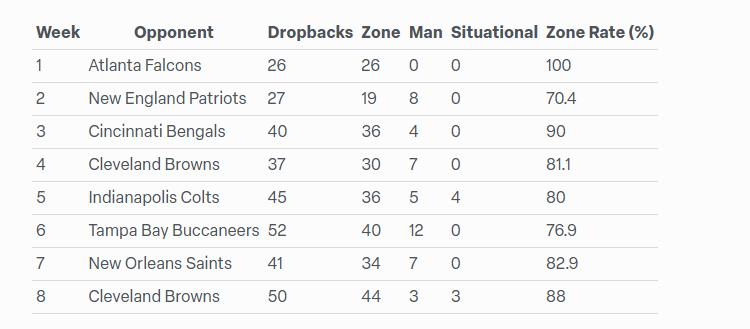
It’s tempting to ask whether the Steelers are living too much in zone, but the numbers suggest it’s serving them well. Pittsburgh ranks ninth in pass EPA. They are tied for fourth in sacks and sixth in takeaways. They are middle-of-the-pack in passing yards allowed — 221 per game, which ranks 16th — but their red zone defense has been excellent. The Steelers have the second-best red-zone touchdown rate in the league. They have allowed just six scores on sixteen red zone possessions for a rate of 37.5%. Only the Vikings are better. Graham’s bend-don’t-break strategy has allowed offenses to complete passes and move the ball between the 30s. But by tightening up near the red zone and forcing teams to kick field goals, it’s saving points. The Steelers give up just 18.0 points per game, which is fourth-best overall.
The potential problem with all of this is that Burrow and the Cincinnati passing game enters Sunday’s contest red hot. Over the past four weeks, they are averaging 36 points per game. Burrow has thrown sixteen touchdowns, is completing 77% of his passes and the Bengals are 4-0. Now that Burrow has film of the first game to study, and with the Bengals passing game operating at maximum efficiency, is all of that zone a recipe for disaster for the Steelers?
Not if they execute well. The Steelers have been zone-heavy this year for a reason. They don’t have the personnel to be a man-coverage team. Without Joey Porter Jr, who was the their best cover corner entering the season, and with the safety position in disarray due to injury, Graham played zone by necessity. It’s worked. And with the defense getting healthier and developing better continuity, the execution of those zone schemes is improving. The Steelers haven’t played a murderer’s row of quarterbacks the past few weeks, but they’ve produced negative EPAs against the pass in three of the past four games (negative is good for the defense).
When did they have their worst game of the season defending the pass? You guessed it. Week 3, against Burrow and the Bengals. Cincinnati’s pass EPA of +0.41 is the highest Pittsburgh has allowed. How will the Steelers contain Burrow, then, in a rematch game where Burrow has a good idea of how they intend to defend him?
They’ll play zone again. But they’ll have to break some tendencies.
That doesn’t mean inventing a bunch of coverages they haven’t played before. It means disguising what Graham has been doing. Showing Burrow something he saw in that first meeting only to change the look post-snap. Blitzing him from different angles with different defenders. Running more simulated blitzes. Finding new ways to rotate from one coverage to another. The blessing in all of this for the Steelers is the fact they’ve had the bye week to work on execution. A team doesn’t have to be complicated with its scheme if they can execute well. In Philadelphia’s Super Bowl rout of the Chiefs in 2024, Eagles defensive coordinator Vic Fangio played zone on 38 of Patrick Mahomes’s 42 dropbacks. That’s a 90% rate, the same as Graham played against the Bengals in Week 3. Fangio wasn’t exotic — he played cover-3, cover-4 and cover-6 — but the Eagles disguised their coverages nicely and they executed exceptionally well.
That’s something Pittsburgh did not do in their first game with the Bengals. There were too many examples like the one I break down below where players voided their zones or did not communicate well enough, leaving windows for Burrow to exploit. With the starters healthy, and with the continuity the team has developed the past several weeks, there is hope the Steelers can execute better this time around.
The Steelers played zone on 90% of CIN's pass attempts in their first meeting in Week 3. Joe Burrow went 28-37 and consistently found voids in those zones for easy completions.
How can the Steelers tighten their zone windows to make things tougher on Burrow? Here's a breakdown: pic.twitter.com/YpKCUDMZID
— Kevin Smith (@KTSmithFootball) November 12, 2026
They’ll need to, or come Monday they’ll be looking up at Cincinnati in the standings.



I doubt the film of the first game would help Burrow dissect our zone coverages much better than what he did in the first matchup.
The real key for us will be, as we did in the first matchup, tackling well and not letting Chase or Higgins turn the underneath stuff into big chunk plays. Keep them in front of you and make the tackle immediately to limit YAC.