A Letter From the Editor: The Steelers offense is proving different isn’t always bad
For a second, I want you to go back to this past offseason and think about what was going on with the Steelers. They were making their defense stronger, all while leaving a lot of questions on the offensive side of the football. Slowly the team started to answer those questions, and it started with the signing of Aaron Rodgers.
After that domino fell, there were more and more pieces of the puzzle which started to come together, but most would argue there was still a lot to be desired when the team went to Latrobe, PA for their annual training camp. The biggest question? Who is the WR2 on the depth chart?
It felt like deja vu all over again, and it seemed obvious the team would be making a move to add to the position. But they didn’t. Instead, they went into the season with four tight ends, and a wide receiver group which consisted of DK Metcalf and what most would consider some “other guys”.
There is no way they go into season with that pass catching group, right?
Wrong.
Okay, but there’s no way that group can be successful, right?
Wrong.
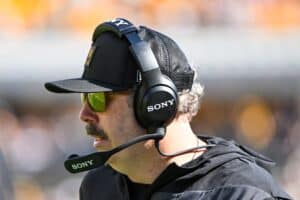
Believe it or not, Arthur Smith has done a tremendous job creating an offense which works for this team. It might not be conventional, and some might call it different, but it’s working.
Through six games the Steelers offense is averaging 203 passing yards per game, ranking 18th in the league, and are scoring 25 points per game, which has them tied for tied for 11th in the league. On top of all that, the Steelers are starting to figure out their running game too. Despite their season average of 94.5 yards per game, 25th in the league, the last three games the Steelers have rushed for the following totals:
- vs. MIN – 131 yards
- vs. CLE – 100 yards
- at CIN – 147 yards
That’s an average of 126 yards per game on the ground, and shows how this “different” offense is really starting to figure it out.
If I’m being completely honest, Smith will have to continue to work on evolving the offense as the season progresses, but I can tell you I have a level of trust in that happening with him at the helm. It was Smith who turned the jumbo package into a means to run the football with efficiency, and has now added wrinkles to the package which have helped in the passing game as well. Just speaking about Smith, he was also the coordinator who got something out of Justin Fields and Russell Wilson last season, where those two signal callers have floundered in their new homes in 2025.
Smith might do things differently, but that doesn’t always mean it is a bad thing.
Which brings me to my next conclusion. It’s time for the defense to follow suit.
We’ve seen the same Steelers defense for almost the entirety of Mike Tomlin’s tenure in Pittsburgh, but what could possibly change? How could they look drastically different, but getting better results? The answer to that question should be answered by those who know more about the game than me, but I will say the team does truly have some options as it pertains to how they structure their defense.
Some ideas:
- Mix some different odd man fronts into the equation to get better personnel, like Brandin Echols, onto the field in big situations
- Lean on playmakers like Nick Herbig, despite the situation
- Be willing to go against the grain, and conventional wisdom, to get the desired result
- An understanding that sometimes the “plan” isn’t working and must be diverted from to see positive results
You see what I’m saying.
There is too much talent and experience on the Steelers defense for them to be this statistically bad. Some of their yearly totals are almost vomit inducing, and it will be up to the coaches and players to find a way, even if it is unconventional, to get the desired results happen with regularity.
Sometimes different isn’t a bad thing, the Steelers offense has shown that. Time for the defense to follow suit.



Not only do I agree with your premise, I am of the opinion that different is almost aways better. Any time you force an opponent out of what they want to do you have an advantage – that’s what “different” does.