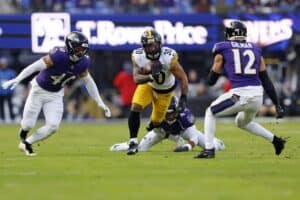
5 thoughts on the Steelers 27-22 win over the Ravens on Sunday
The Steelers reclaimed the lead in the AFC North by defeating the Baltimore Ravens 27-22 on Sunday. Here are five thoughts on what transpired at M&T Bank Stadium.
1. Steelers get explosive
You may have heard this statistic repeated several times on the CBS broadcast. Entering the Baltimore game, Pittsburgh had not completed a pass that travelled more than twenty yards in the air since October 26th against Green Bay. That was a span of over six games and 200 passing attempts.
And then, on their first offensive snap of the game, this happened:
What a throw from Rodgers to kickstart the day for the Steelers offense. Pocket holds up to give him time to set his feet, and Rodgers drops a dime. pic.twitter.com/SMqEbKXlCv
— Kevin Smith (@KTSmithFFSN) December 7, 2025
It was an aggressive start, and it set a tone for the afternoon. Aaron Rodgers threw for a season-high 284 yards, and the Steelers, who had just seven completions of twenty or more yards the entire season, connected on five such throws against Baltimore. Pittsburgh scored all 27 of its points on drives that contained an explosive play. Generating explosives was the key to one of their best offensive performances of the season.
How did they do it? It started with solid pass protection. Rodgers was not sacked once, and on many throws had ample time in the pocket to seek out second or third options. On this long completion in the third quarter, he held the ball for almost seven seconds before finding Metcalf for 41 yards:
Good things happen when Rodgers has time to throw. pic.twitter.com/vkmE1hlAj6
— Kevin Smith (@KTSmithFFSN) December 7, 2025
That additional time allowed Rodgers to set his feet and have clear sightlines to his targets. This resulted in perhaps his most accurate passing performance of the season. Several of his throws, like this beauty to Calvin Austin, were perfectly placed. Rodgers hasn’t had the luxury of time very often this season, and he proved that when it’s provided, he can still be an elite passer:
Vintage Rodgers. Back foot throw, 30+ air yards on the money. Assist to Gainwell for helping LT Dylan Cook with a chip on Cook’s first NFL rep. pic.twitter.com/ulcjHKtBDc
— Kevin Smith (@KTSmithFFSN) December 7, 2025
2. DK’s Big Day
Metcalf helped generate three of Pittsburgh’s explosives, and finished the day with seven catches for a season-high 148 yards. Rodgers targeted him four times on Pittsburgh’s opening possession, and continued to feed Metcalf throughout the afternoon.
The strategy most defenses have used against Pittsburgh this season has been to shade a safety over Metcalf to double him, then press the other receivers and make them win one-on-one. I haven’t seen the All-22 yet, but at first glance, Baltimore seemed to stray from this strategy. They did not seem to double Metcalf very often, or to commit safety help in his direction.
One reason for that could be because the Ravens generally play the Steelers in a single-high structure and chose not to depart from that philosophy. Or, it could be that the presence of Adam Thielen and Marquez Valdes-Scantling, the two veteran receivers the Steelers signed who were both active for the first time, dissuaded Baltimore from favoring Metcalf. Thielen, at 6’2, and Scantling, at 6’4, are big enough to win on sideline jump balls against Baltimore’s smaller corners. When Pittsburgh split one of those big receivers opposite Metcalf, it became hard for Baltimore to commit safety help to one side. Again, until I see the All-22, I won’t swear this was the case. But it felt that way watching the game live.
If the Steelers can sustain a threat opposite Metcalf, and force defenses to honor it, Metcalf proved that he could be the elite receiver Steelers’ fans have been expecting. Unlocking Metcalf unlocked the offense as a whole. On a day when Pittsburgh ran the football poorly, that made a huge difference.
3. Next (Men) Up
The “next man up” mantra is one of Mike Tomlin’s most reliable lines. When Tomlin talks about the standard being the standard, one of the things he’s referring to is the expectation that when one player leaves the lineup, whomever takes his place will uphold an expected level of play.
This was put to the test on Sunday, as injuries sent a steady stream of Steelers to the bench. Linebacker Malik Harrison exited with a concussion. As did tight end Darnell Washington. As did left tackle Andrus Peat, who was starting in place of the previously injured Broderick Jones. Brandin Echols left the lineup briefly before returning, as did Patrick Queen. It felt as though the Steelers might literally run out of bodies.
Fortunately, the players who took their places filled in admirably. Cole Holcomb, who replaced Harrison, finished with a team-leading nine tackles. Dylan Cook, who took the first live reps of his professional career, replaced Peat without disaster. That’s far from high praise, but given the fact Cook is normally a third-string tackle, it’s no insult, either. The Steelers pieced together replacements for Washington, granting more reps to Pat Freiermuth and Jonnu Smith, and cycling through a host of receivers. When Echols left, Chuck Clark and Jabrill Peppers both saw time in the slot.
It probably isn’t a coincidence that Baltimore got the better of the play in the fourth quarter, as Pittsburgh’s reserves received the bulk of their playing time. But the fact the Steelers avoided a meltdown with so many new faces in the lineup is a testament to their preparation, and to Tomlin’s well-worn mantra.
4. Receiving Backs
The official title for Jaylen Warren and Kenneth Gainwell is, of course, running back. But with the way they’ve been used this season, “receiving back” feels just as appropriate.
Warren scored Pittsburgh’s final touchdown on Sunday, catching a throw to the flat from Rodgers against the blitz and running untouched into the end zone for a 38-yard score. He is fourth on the team in receptions this season, with 30:
Watch Rodgers acknowledge the play call from Arthur Smith at the end of this clip. Great job by Smith of anticipating the blitz from BAL and dialing up a beater. Huge drive for PIT! pic.twitter.com/Eb4LMn8ppx
— Kevin Smith (@KTSmithFFSN) December 7, 2025
Gainwell is the team’s de facto “WR2.” His 50 receptions trail only Metcalf (by two), and he may lead the team in catches before all is said and done. While the lack of production from Pittsburgh’s receivers has hamstrung the offense, integrating the running backs into the passing game has been helpful. Gainwell, in particular, has been a revelation since coming over from Philadelphia as a free agent last off-season. His versatility has given the Steelers a weapon at running back they haven’t had in years, one they can line up anywhere in the formation and use as creatively as they can imagine.
They will need more production from their perimeter players if they’re going to win the AFC North and perhaps make some noise in the post-season. In the meantime, Gainwell and Warren have proven to be viable options as pass-catchers.
5. Odds and Ends
a. A quick shout-out to linebacker Carson Bruener, who was a special teams ace on Sunday with three excellent tackles on kickoffs. I liked this one in particular, where Bruener steamrolled a blocker before tackling the returner:
Props to Carson Bruener (44) on this kickoff. Bruener (third from right) runs over his blocker, then gets flat and pursues the return to make a nice tackle. Excellent special teams rep from Bruener. pic.twitter.com/7VUpUm9UtR
— Kevin Smith (@KTSmithFFSN) December 7, 2025
b. I disagree with the officials’ decision to rule what looked like a touchdown to Isaiah Likely an incompletion because he didn’t “complete the process of the catch.” He caught it and took two steps in the end zone before Joey Porter knocked it out. To me, that’s a touchdown. But am I complaining? Hell no. May the future ghost of Jesse James rest in peace.
c. The Steelers miss Derrick Harmon desperately. They entered the game giving up 4.0 yards-per-carry when Harmon was in the lineup, and 4.6 per-carry when he was not. With Harmon absent on Sunday because of a nagging knee injury, Baltimore rushed for 217 yards and an average of 5.4 yards per rush. Amazing what a difference the rookie first-round pick has made when he’s been available. If only he could stay healthy.
d. The difference on the scoreboard was largely a product of each team’s performance in the red zone. The Steelers scored two touchdowns and added two field goals on four red zone trips, while the Ravens visited the red zone six times and were held to two touchdowns, three field goals and a turnover on downs.
e. Alex Highsmith’s sack of Lamar Jackson to end the game was a satisfying conclusion, and put an exclamation point on Pittsburgh’s ability to frustrate Jackson throughout the day. Jackson finished just 19-of-35 passing, threw a bad interception, and was unable to create explosive plays with his legs. He did score on an six-yard run, and he was limited by a balky ankle, but the Steelers did a nice job of confining him to the pocket and making him beat them throwing the football. That’s what you have to do to hold the Ravens offense in check. Despite giving up some big yardage numbers, Pittsburgh’s defense, with all of its replacement parts, passed its most important test of the season.
Highsmith for the win!
What a gutty effort from the Steelers. Banged up, plenty of adversity, they found a way to win.
Jesse James has finally been redeemed! pic.twitter.com/MP0eLOt8v7
— Kevin Smith (@KTSmithFFSN) December 7, 2025
For more of my work, follow me on X @KTSmithFFSN, and tune into the “Here We Go” podcast every Monday with Bryan Anthony Davis, as well as my “Call Sheet” show every M-W-F.



Regarding how Baltimore played Metcalf… it was similar to how other teams have done it. They shaded the safety towards him and played man everywhere else. The Steelers just protected Rodgers better and did a good job of manipulating the safety to keep him from jumping Metcalf too quickly. Baltimore didn’t change from what other teams have done. The Steelers just had a better plan and executed better.
It helps that Baltimore’s pass rush is incredibly limp. I’m sure you’ve all seen the stat that Myles Garrett has more sacks than the entire Ravens team, but I’m including it here anyway – I enjoy seeing it in print.
Kudos to Keeanu Benton for playing his heart out in the middle of the DL. He tends to play second fiddle to Harmon nowadays but he’s a great player in his own right who has improved each year.
I have to disagree with you on the Likely TD being reversed. This is obviously a touchy subject throughout the league and, as much as people have complained over the years, the NFL has ruled fairly consistently when it comes to catches. The rule states that you have to have the following elements for a completion:
In order to meet the third element, he has to maintain control of the ball, which he didn’t do because it got knocked out, or perform a football move, which he also did not do. He didn’t tuck the ball, he didn’t turn up field, he didn’t complete a third step. I think this is a clear example of the rule is crap, but it was officiated in accordance with the rule.
This is also why the Jessie James catch irked so many Steeler fans. James caught the ball, had a knee down, and made a football move by turning up field to cross the goal line. Jessie James completed the catch. Isaiah Likely didn’t complete all 3 elements.
Agree.
I agree with you as far as the interpretation of the rule is concerned. I just don’t agree with the rule.
On a play to the sidelines, you have to get two feet down and demonstrate control of the football. If you’re knocked out of bounds before “making a football move,” it’s still a catch. Why is the criteria for making a catch different in the middle of the field? It feels like the league sometimes finds rules to justify the calls they make, like the Jesse James Rule and the Tuck Rule, and not the other way around.
To paraphrase the great Marv Levy, who passed away today at the glorious age of 100, too many over-officious jerks ruining the game.
I don’t think the criteria is different on sideline catches. On a sideline catch, they meet the 3rd element by maintaining control of the ball throughout the process, so they don’t have to make the “football move.” That’s why you see them get ruled as incomplete when the ball moves as they fall out of bounds. Those get called incomplete because the receiver didn’t make a football move NOR did he maintain control of the ball. When it is ruled a completion, they meet all 3 elements: 2 feet, possession, and completed the pass by maintaining control of the ball (in lieu of a football move).
Agree again. If the league doesn’t like the current criteria for a completed catch, they can change it, as they attempted to with the “brotherly shove”. The rule in place yesterday was adhered to properly… that in itself surprises me with NFL officiating as it is presently.
I don’t like the “brotherly shove”. I think the offense is given an unfair advantage being allowed to block ahead of the ball carrier and while also pushing the ball carrier from behind. Defensive players cannot push their teammates from behind to achieve an equal but opposite effect to halt the ballcarriers’ progress.
Some folks don’t like that if a ballcarrier fumbles (occasionally negligently drops) the ball in the field of play, and if the ball travels into and out of the endzone, the opposite team is awarded a touchback (a rugby holdover from the 19th century). This is different from fumbling out-of-bounds in the field of play. This could be changed–I’d dislike that if it were to happen.
In the Colts game, fans were in an uproar when a Colt “muffed” the punt and a Steeler picked up the ball and advanced it to score… the rule since the 1940’s states that the punting team cannot advance the ball in such a situation. As I recall, this rule was put into place to encourage punt returners to field the ball in the first place. Another rule change opportunity…
The NFL is notorious for overly complicated rules. Just like the two feet rule. George Pickens hops twice on the sideline on the same foot but it doesn’t count as two feet because it was the same foot. When fans see something that is a catch there shouldn’t be some odd rule that overturns it.
I hear you aarnold222 but that third step in the rule’s criteria is nebulous as all get out. It calls for a “football move” but isn’t attempting the third step a “football move” in and of itself? The rule doesn’t seem to require completion of the football move.
This brings me to a larger point which is why I think that catch should have counted. Replay was meant to reverse obvious mistakes. Was that TD call an obvious mistake? Merely the way we are debating it tells me that no, it wasn’t obvious. In those instances the call on the field should prevail.
I think NFL refs have started down a similar path that college refs have taken with targeting calls. They make the call on the field as targeting (or TD) because then it’s automatically subject to review.
NHL refs are starting to do the same with major vs minor penalties. They call the major, because review can reduce it to a minor, but cannot turn what was called a 2 minute minor into a major penalty.
I think it comes down to, “you have to draw the line somewhere.” Is attempting to make the third step a football move? Maybe. Or is it just attempting to make a football move? When do you consider him to be attempting to make a third step? When his foot comes off the ground? Then would the “football move” just be lifting one of your established feet off the ground?
I also think the replay showed obvious proof that the rule was upheld. The discussions I’ve had have been more about the rule, not whether it was followed on the field. The problem (a problem there is no solution for) is that no matter how much you define a catch, no matter how much you refine a rule, at some point it comes down to a judgement call at some point, and I think that’s what happened here.
You are exactly right. Based on the way the rule was written, it was obvious when looking in slow motion. People who think it wasn’t is because they want to nitpick the rule and use the term “football move” (which is not in the rule) because they don’t know/understand what the officials are looking for.
I hope you checked out my article breaking down the rule.
I think the rule is stupid. I think the ruling — based on a stupid rule — was correct. Sucks to be Baltimore! Also, I LOVE the finishing flare on this point Kevin! LOLOL
I am with you as well but for a bit different reasoning. The call clearly could have gone either way as evidenced by the way it has been debated since it happened. What ever happened to notion that, in these instance, the call on the field should prevail? It really is like Jesse James all over again, just for the other team.
Fair. Which is why I KNOW it has to suck for Ravens fans today. Heck, James’ “catch” was in December, 2017 and Steelers Nation is STILL talking about it. But the brutal truth is that both were correct calls given the NFLs definition of a catch at the respective times the catches were “made”.
And all that still doesn’t change the fact that I think it’s a stupid rule (at least the way it’s written and enforced).
Now you see, I am still peeved over the James no-catch for the same reason. 8 years later and there still isn’t consensus on it (I still think it was catch even within the context of the rule). I come back to my over-arching point, though, If it’s that close of a call, just go with what was called in the field.
Video is being used in pursuit of perfection and that wasn’t its intention. Its intention was to reverse obvious mistakes and, in all three of the examples that we are talking about (Rodger’s catch, Ravens TD catch, Jesse James) none of those calls were obvious mistakes yet video was still employed.
I am all for replays, by the way. I just think that the “too close too call” stuff should be left alone.
Hey, I’m still peeved over the James reversal as well. 🙂 Mostly because it seemed he DID “make a football move” in diving for the end zone while twisting his body to get there. I think that was a much easier call to make actually (in favor of a catch) but I was at that game sitting in the end-zone where the catch was made and it took a literal 15 minutes to get big Al’s call from NY. And then he blew it anyway. LOL
I was watching the defensive line with care because Harmon was out, and I knew it might be a problem. It seems to me that Cam Hayward fires out much, much lower than the other lineman, and stays low as he moves into contact. It was especially true for Yahya Black, but is still the case for Keanu Benton even though he has improved. Why is this seemingly simple skill so hard for defensive lineman to master? It seems to make a huge difference in how easily they get washed down the line.
Probably just very basic stuff – flexibility / stiffness, especially when you are tall and when you are playing tired.
I think if you look at both Black’s and Benton’s draft profiles that was one of the big issues for them. Most of the time it is feet and pad level that separate Round 1 guys from the rest. Black was projected as a 4-5 round guys and Benton as a 2. They both were drafted in their range and have exhibited the strengths and weaknesses that were listed for them.
I do a lot of draft work and know this well. What I have never grokked is why these young men – professional athletes! – find it so hard to fix. I’m pretty good at body dynamics, and can say with authority that keeping your center of gravity low is fundamental. And it isn’t hard to teach; it being understood that balance points move higher as people get tired.
Just think of wrestlers, a sport many of these kids studied in HS. Even the goliath super heavyweights understand that the low man wins. There’s no good reason for someone like Black to stand up before moving when the ball is snapped, and every reason not to. And yet it remains true that young players perpetually show the same issue.
Good observation on Black. The big knock on him coming out of college was that he plays too high, and that’s still an issue. I think bad habits like that get fossilized at some point, and if you don’t break a player of them early enough they are tough to get rid of. Especially when you are 6’6-335.
The defense is totally different against the run with and without Harmon. He’s made a huge impact when he’s been available. Unfortunately, that hasn’t been often enough.
There’s still time to “fix” Black.
I do believe if Benton hasn’t gotten that by now, he likely never will.
Benton has gotten better at it. I don’t mean to imply otherwise. It’s the obvious difficulty that I don’t understand. Take the time to watch for it next week. Cam is lower in his stance; fires out lower from his stance, and remains lower as he initiates contact. Yes, he is a special player and a fringe HOF prospect, but these are fundamentals. You’d expect to see the differences come out in motion and reaction, but in stance? And in standing up rather than moving in off the first step? Why?
Why isn’t this drilled in as a “white belt” fundamental even HS, just like it is for wrestling, judo, or any of the other grappling/martial arts? It’s even emphasized heavily for pitching! Exhausted athletes stand up, and sometimes even lock their legs. Understood. But doing it when you’re fresh, despite all the problems it causes…? How do coaches fail to fix that from the very start?
I get that there must be a reason. And that it must be harder than it seems, because these young men are natural athletes despite their size. The wiring is there. I’m just trying to understand what the issues really are, and why they tend to plague defensive linemen more than their counterparts on offense.
Just a guess, but a guy like Black may have gotten away with bad technique for a long time simply because he was bigger and better than everyone else. I see that all the time. Guys with big physical advantages who don’t become tacticians because they allow their natural gifts to lead. That works until it doesn’t. Which for many of these guys is the NFL.
Not saying Black falls into the “unfixable” category. Only that this may be how he got here.
I totally agree with your point that these basic fundamentals must be constantly reinforced until they are the second nature. Perhaps if they’re playing more fundamentally sound in the trenches they won’t become “exhausted athletes that stand up”.
Not for nothing but the league just admitted that the roughing call on the Steeler field goal, which eventually turned the FG into a TD, was incorrect and that no penalty should have been called.
As Steelers fans, we should probably remember this game the next time the Steelers get screwed over by bad officiating.
Nah – not like we can’t remember plenty of times the Steelers have already been screwed over by bad officiating. And league letters of apology that don’t mean crap because they don’t change the outcome.
Don’t expect me to shed a single tear for Baltimore just because it happened to them this time.
Kenneth Gainwell is like a budget Darren Sproles. While Najee is still a great traditional RB, Warren & Gainwell can be used to run, pass protect, or get a check down pass and make magic happen, like how Sproles was used. It’s great to have check downs that are actually a huge threat and I think their rapport with Rodgers is only improving as the season goes on.
a true Pittsburgh Steelers fan, since the 70’s the Baltimore Ravens shouldn’t have scored 22 points